

Person-centered prostheses and implants
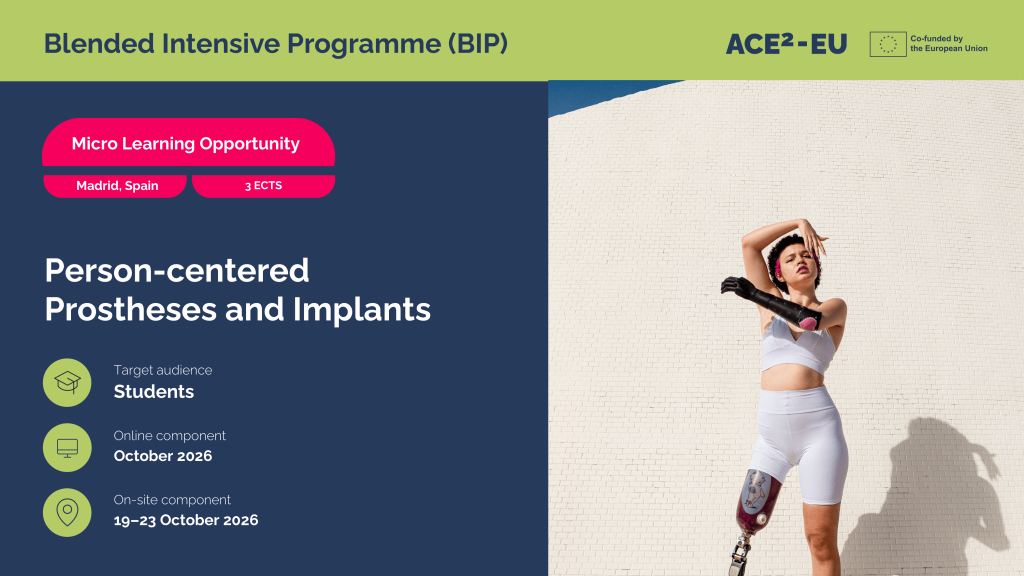
Course Type: Blended Intensive Programme (BIP)
Duration: Synchronous online — 5h · On-site (physical mobility) — 25h · Independent and group work — 45h
Dates: Online component — October 2026 · On-site component — 19–23 October 2026
Credits: 3 ECTS credits — awarded upon at least 80% attendance and satisfactory achievement of the learning objectives
This fully applied international course addresses the design, fabrication and validation of prostheses and implants through a person-centred approach that considers biomechanical, therapeutic, emotional and quality-of-life dimensions of the patient. Drawing on biomedical engineering, mechanical and industrial engineering, materials science, physiotherapy, dentistry and psychology, students engage with clinicians, patients and industry-grade additive manufacturing technologies to design and produce customised prosthetic prototypes that respond to real clinical needs.
Application deadline
Applications are now closed.
Lead and Host Institution: UFV (Madrid)
Partner Institutions: UGD (North Macedonia), MUG (Poland)
External stakeholders: Hospital Universitario de Toledo
Online preparation — Welcome video and course introduction with brief online forum introductions and expectations. Introductory videos for each in-person module (four short videos, each presented by the module instructor, with a Q&A forum). Video introducing the hospital visit with a short written reflection on expectations. Optional theory videos (Fusion 360, 3D printing basics, CAD principles) with an optional practical exercise or self-assessment quiz.
On-site week (19–23 October 2026, UFV Pozuelo de Alarcón, 5 days, 25h):
Day 1 · 19 Oct — Hospital Visit (Hospital Universitario de Toledo): Guided tour, observation of rehabilitation and prosthesis adaptation processes, talks with professionals from various fields and group reflection.
Day 2 · 20 Oct — Module 1: Applications and Project Design: Why 3D printing: clinical and non-clinical applications of 3D printing, comparison with traditional manufacturing, project design in interdisciplinary teams, initial project presentations and validation of proposals by the instructors.
Day 3 · 21 Oct — Module 2: 3D Scanning, Design and Materials: Practice with 3D scanning, introduction to Fusion 360, overview of 3D printers and materials, and discussion on material selection based on clinical cases.
Day 4 · 22 Oct — Module 3: Printing and Redesign: 3D printing of prototypes, identification and correction of errors, iterative redesign based on feedback and group discussion.
Day 5 · 23 Oct — Module 4: Mechanical Testing, Simulation and Redesign: Basic mechanical testing, digital simulation of prototypes, final redesign and presentation of results.
Participants will be able to:
- Understand the principles of person-centred prosthesis and orthosis design.
- Identify clinical, biomechanical, therapeutic and emotional patient needs.
- Apply CAD tools and 3D scanning technologies in healthcare applications.
- Select appropriate biomaterials for prosthetic fabrication.
- Design and manufacture customised prosthetic prototypes using additive manufacturing technologies.
- Perform basic mechanical testing and validation procedures.
- Work effectively in interdisciplinary and multicultural teams.
- Develop innovative solutions focused on improving patient quality of life.
By the end of the course, students will be able to:
- Understand and identify patient needs from the perspective of biometric parameters, therapeutic and emotional dimensions.
- Apply person-centred design methods to a real clinical prosthetics challenge.
- Co-create a functional prototype using 3D scanning, CAD (Fusion 360) and additive manufacturing.
- Carry out basic mechanical testing and digital simulation of prototypes.
- Engage critically and ethically with users, clinicians and industry partners.
- Articulate the humanistic dimension of biomedical engineering in their professional practice.
- Work effectively in international, interdisciplinary teams.
Level: Undergraduate and postgraduate students from any ACE²-EU partner university.
Fields: Biomedical Engineering · Mechanical Engineering · Industrial Engineering · Materials Engineering · Physiotherapy · Health Sciences · Biomechanics · Physics · Dentistry · Occupational Therapy.
Suitable for those interested in: 3D printing and additive manufacturing · Digital healthcare technologies · Prosthetics and orthotics · CAD and 3D design · Biomechanics and rehabilitation · Human-centred healthcare innovation · Multidisciplinary teamwork and innovation.
Universities: Open to students from any ACE²-EU partner university.
Language: English B1–B2.
Apply here: https://forms.gle/7Uo1rgwCYmLEz2Sd7
Application Deadline: 20 July 2026
Please note that submitting an application does not guarantee a place on the programme. Participating institutions apply their own internal selection procedures.
Prior to the start of the course, selected participants will receive a welcome email from the ACE²-EU Alliance containing detailed information and instructions specific to the programme.