
FH-Prof. Dr. Eithne Knappitsch — e.knappitsch@fh-kaernten.at

RACE LAB: Rethinking Action for Conscious Entrepreneurship
30 November 2026
-
5 December 2026
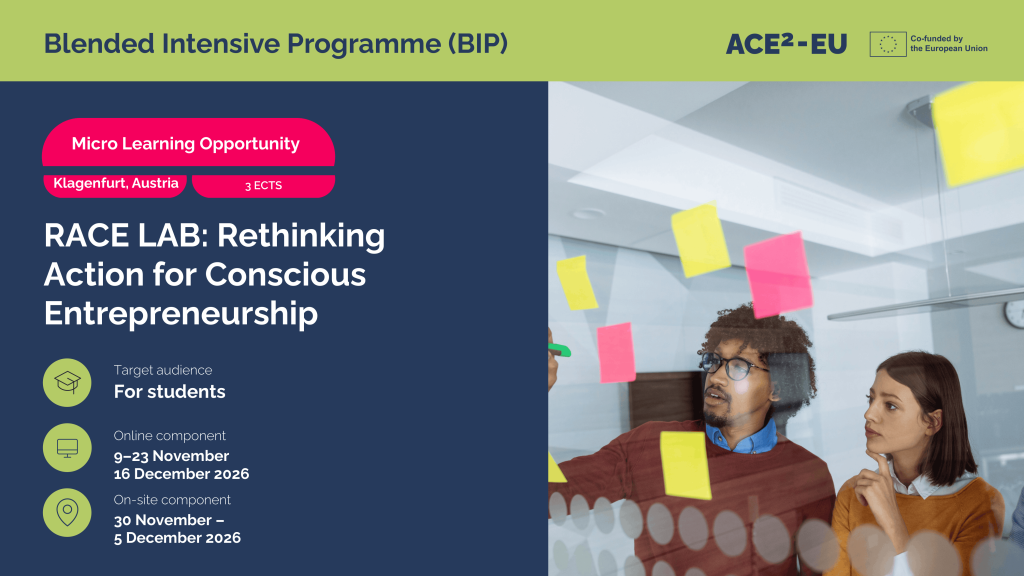
Course Type: BIP
Duration: 75 hours (total workload)
Dates: Online component from 9–23 November 2026 (final presentation: 16 December 2026) · On-site component – 30 November – 5 December 2026, Klagenfurt, Austria (Makerspace Carinthia)
Credits: 3 ECTS credits and a certificate of attendance
How do you build a business that succeeds without costing the planet? The RACE LAB introduces students to sustainable entrepreneurship — combining environmental and social responsibility with viable business thinking. Working in international, interdisciplinary teams, participants develop sustainable business ideas from first spark to a refined business model, culminating in a final pitch before a jury.
Application deadline
00
Days
00
Hours
00
Minutes
00
Seconds
Applications are now closed.
Carinthia University of Applied Sciences: Dr. Anna Zinenko (CUAS · UAB–FUABformació), FH-Prof. Dr. Eithne Knappitsch
Partner Institutions: Santarém Polytechnic University, Universidad Francisco de Vitoria, Technische Hochschule Ingolstadt
External stakeholders: Carinthian Chamber of Commerce, Global Case Study Challenge, Startup Carinthia, Makerspace Carinthia
The programme tackles real challenges: how climate change, resource exhaustion and shifting consumer expectations are reshaping what a successful business looks like. Students gain direct access to the Alps-Adriatic startup ecosystem through the course’s partners, learning from practising entrepreneurs, business owners and consultants. No prior business or entrepreneurship knowledge is required — curiosity and a willingness to collaborate across disciplines and cultures are the only prerequisites.
Aims: introduce the principles of sustainable entrepreneurship · turn ideas into viable, responsible business models · foster international, interdisciplinary teamwork · connect students with a real startup ecosystem · build confidence around risk and the fear of failure · develop pitching and communication skills.
1. Online preparatory phase (9–23 November 2026) – Three synchronous online sessions prepare students for the on-site week: building teams across institutions and cultures, introducing the key concepts of sustainable entrepreneurship and sustainable business-model design, and guiding first idea generation linked to the UN Sustainable Development Goals. Students also complete preparatory team-building activities remotely.
2. On-site mobility week (30 November – 5 December 2026 · Klagenfurt, Austria) – Hosted at Makerspace Carinthia, students move from innovative ideas to marketable sustainable products. The week combines interactive workshops (ideation, prototyping, design thinking, business-model development), team-based project work, one-to-one coaching with entrepreneurs and consultants, a dedicated workshop on the fear of failure, and pitch training. Culminates in a pitching competition before a jury, followed by a learning-transfer session.
3. Follow-up & reflection (16 December 2026) – A final online reflection session consolidates learning, supports transfer into students’ own academic and professional contexts, and closes the programme.
Learning Objectives:
- Build a comprehensive foundational understanding of sustainable entrepreneurship.
- Collaborate effectively in international, interdisciplinary teams, both remotely and in person.
- Generate and develop innovative, sustainable business ideas linked to the UN Sustainable Development Goals.
- Apply business modelling, prototyping and design-thinking methods to develop a sustainable venture concept.
- Reflect on the role of risk and the fear of failure in entrepreneurial practice.
- Design and deliver a compelling pitch for a sustainable business idea.
Learning Outcomes by the end of the course, students will be able to:
- Explain the principles of sustainable entrepreneurship and apply them to the development of new business ideas.
- Develop and refine a sustainable business model using established tools such as the Business Model Canvas.
- Apply prototyping and design-thinking methodologies to move from idea to tangible concept.
- Work productively in culturally diverse, interdisciplinary teams in both virtual and face-to-face settings.
- Communicate and pitch a business idea persuasively to an expert audience.
- Reflect critically on their own entrepreneurial mindset, including attitudes toward risk and failure.
Open to undergraduate and postgraduate students from ACE²-EU partner universities, particularly those studying or interested in: Business, management and economics · Engineering and technology · Sustainability and environmental studies · Design and innovation · Social sciences and related disciplines.
Especially good fit for students interested in: entrepreneurship, innovation and startup ecosystems · sustainability, the circular economy and the UN Sustainable Development Goals · international and cross-cultural teamwork · developing, prototyping and pitching their own ideas.
Recommended Language Level: English B1–B2 (mandatory, as English is the working language of ACE²-EU courses).
Interested applicants should apply here: https://forms.gle/hD9kf6Q12kxh9Gob6
A notification of acceptance to participate will be sent to successful applicants by the host institution. Prior to the start of the course, participants will receive a welcome email from the ACE²-EU Alliance with detailed instructions specific to the course.