

This event has passed.
Taste of Culture: Cultural Heritage in Transition
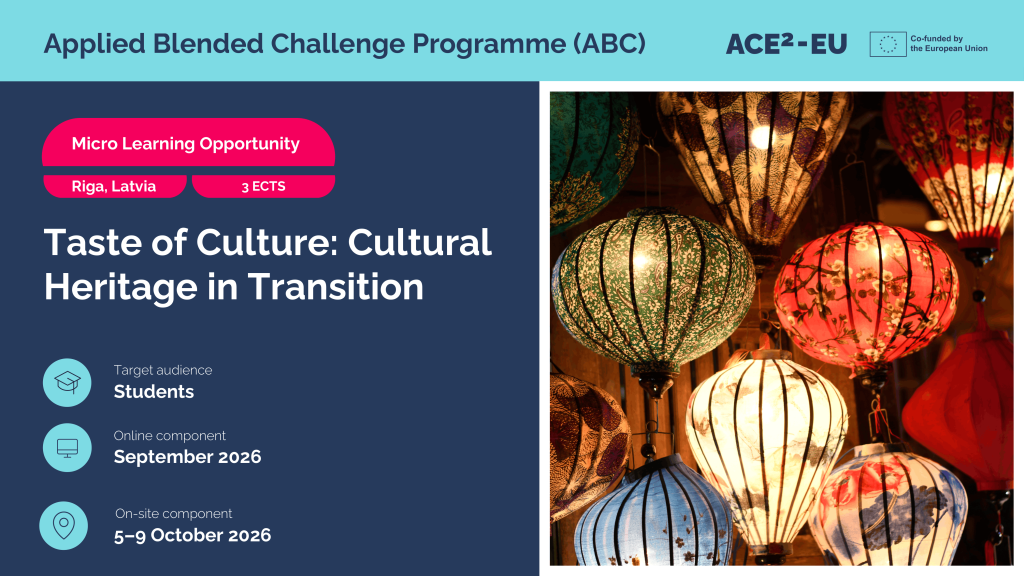
Course Type: Applied Blended Challenge (ABC)
Duration: Synchronous online — 17h · On-site (physical mobility) — 35h · Independent and group work — 30h
Dates: Online component — October–November 2026 · On-site: 5–9 October, Riga, Latvia
Credits: ECTS credits — awarded upon at least 80% attendance and satisfactory achievement of the learning objectives
This course explores how we tell real stories through photography, using both analogue (film) and digital techniques. The main challenge is to understand how different tools and processes influence the way we see, record and interpret the world around us. The course is designed for students from different audiovisual disciplines and countries.
Application deadline
Applications are now closed.
Latvian Academy of Culture, Latvia — Teachers: Ieva Vītola, Rasa Laua
Universidad Francisco de Vitoria, Spain
Polytechnic University of Santarém
External stakeholders: Food Markets in Riga — Rīga Central Market · Āgenskalns Market · Vidzeme Market (host study visits during the on-site week, real-world context for traditional food and consumer culture); Museum and Research Centre “Latvians Abroad” (heritage and research perspective on diaspora foodways and cultural identity); Entrepreneur of traditional food (hands-on workshops and masterclasses, first-hand entrepreneurial perspective on sustaining traditional products)
The course tackles a real-world challenge: traditional food products and cultural heritage are losing ground to fast food, globalization, and cheaper synthetic alternatives. Students work in interdisciplinary, international teams to develop creative solutions that reconnect younger generations with traditional food culture.
The learning journey starts online with lectures on cultural identity and consumer habits, then moves to Riga for hands-on workshops, market visits, stakeholder dialogues, and group project work with local food producers and cultural entrepreneurs. The programme places strong emphasis on intercultural collaboration, critical thinking, and holistic understanding of sustainability as a cross-sectoral theme — bridging cultural heritage, community development, entrepreneurship, environmental responsibility, and creative industries.
Online sessions (14, 21, 28 September 2026 · 16:00–18:00 CET · 8h synchronous + independent and group work): Three sessions combining lectures with independent and group work. Kick-off: course briefing, objectives and introduction to the challenge; key concepts — cultural heritage (tangible and intangible), how globalization and modernization influence traditional products and local identities. Lectures on cultural identity and heritage, the modern consumer’s taste, changing consuming habits. Group work in breakout rooms (2–3 students) — tell each other about one traditional food in your country. Homework briefing: choose one traditional food in your country and make its “Dating Profile of local/national traditional food” (using template). Independent work — research and prepare the “Dating Profile” for the chosen local/national traditional food.
On-site sessions (5–9 October 2026 · Riga · 40h): Participants work in interdisciplinary teams to explore the topic “Taste of Culture: Cultural Heritage in Transition — Sustaining Traditional Products in the 21st Century”, addressing challenges related to preserving cultural identity, supporting local producers, balancing authenticity with innovation, and promoting sustainable cultural practices in a globalized world. Hands-on workshops and masterclasses with traditional food producers. Study visits to local markets, museums, cultural enterprises and traditional production spaces. Stakeholder dialogues with cultural practitioners, entrepreneurs, sustainability experts and community representatives. Creative sessions integrating storytelling, design thinking, intercultural exchange and community-based learning. Group projects focused on developing innovative ideas or concepts for sustaining and promoting traditional cultural products in contemporary society.
Follow-up & reflection: Reflective learning logs and final group deliverable. Individual reflection on heritage, sustainability and entrepreneurship.
- Understand the socio-cultural and environmental value of heritage-based products.
- Collaborate with real stakeholders to co-design viable strategies for increasing the relevance and appeal of traditional products.
- Develop creative, sustainable, and culturally sensitive solutions aligned with EU priorities (Green / Digital transitions).
- Strengthen skills in challenge-based learning, intercultural communication, and co-creation.
- Connect students with European heritage through cultural heritage.
- Foster intercultural collaboration and dialogue.
Level: Undergraduate and postgraduate students from ACE²-EU partner universities.
Fields: Cultural management and event studies · Nutrition and food studies · Social sciences (sociology, anthropology, cultural studies) · Audiovisual Communication, Cinema, Photography · Environmental sciences, ecology and sustainability studies · Engineering, logistics and resource management. Open to any specialization with interest in culture, heritage, tourism and creativity.
Language: English B1–B2.
Apply here: https://forms.gle/5orL9pYVajgJ2WMCA
Deadline for receipt of applications: 10 July 2026
Please note that submitting an application does not guarantee a place on the programme. Participating institutions apply their own internal selection procedures. Prior to the start of the course, selected participants will receive a welcome email from the ACE²-EU Alliance containing detailed information and instructions specific to the programme.