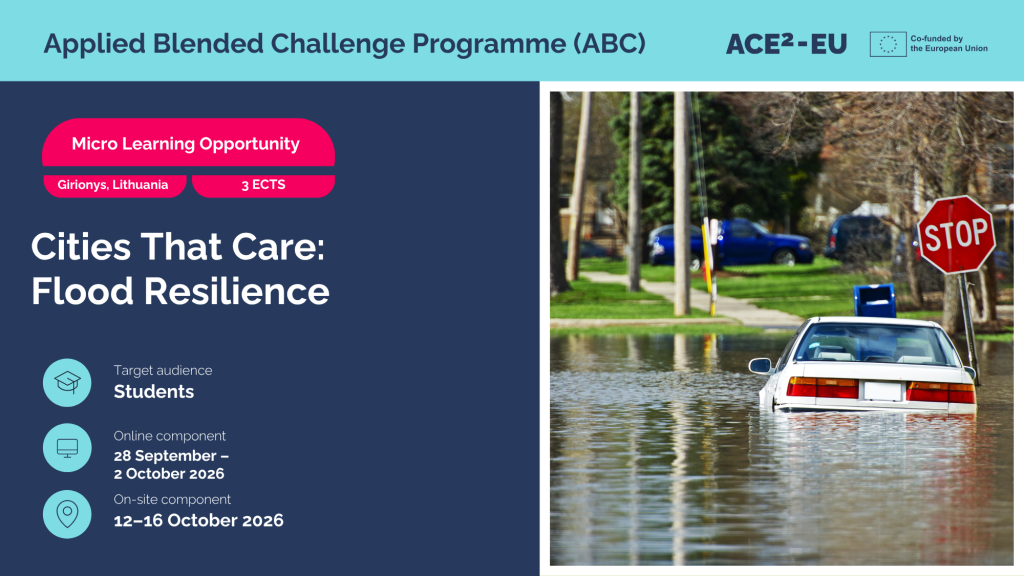
Online sessions: The online component will prepare students for the physical mobility and establish a shared interdisciplinary foundation. Students will be introduced to the ABC learning approach, the ACE²-EU Alliance and the main course challenge. They will explore the relationships between climate change, floods, public health, economic impacts, sustainable construction and urban resilience. Participants will also begin working in international groups. As a preparatory assignment, students will identify five important flood-related problems in their country and consider possible ways to address them. Their findings will be developed into short presentations for the first day of the on-site programme.
Onsite sessions: Dates: 12–16 October 2026. Main location: Liepų St. 1, Girionys, Kaunas District, Lithuania. Additional locations: Kaunas city and the Kaunas region. The physical mobility will combine workshops, practical exercises, stakeholder engagement, challenge-based teamwork and field visits.
Students will explore: flood management and urban surface water management; climate change and changing flood risks; sustainable and flood-resilient buildings; green roofs and nature-based solutions; health and economic consequences of floods; hydrotechnical structures and hydroelectric infrastructure; spatial data and map-based flood assessment; identification of safer territories; emergency preparedness and evacuation during floods; the role of wetlands in water retention and ecosystem resilience.
Field activities will include visits to Nemunas Island, a hydroelectric power plant and the Dubrava wetland. Students will also engage with the Lithuanian Riflemen’s Union to examine community preparedness and evacuation during flood emergencies.
International teams will use the knowledge gathered during the online and on-site components to develop integrated proposals for more flood-resilient cities and communities.
Follow-up / reflection: At the end of the physical mobility, student teams will present their proposed solutions and receive feedback from lecturers, peers and participating stakeholders. Learning will be consolidated through: final interdisciplinary group presentations; peer and lecturer feedback; a short individual reflection; a final group output describing the challenge, proposed solution, expected benefits and possible implementation steps; dissemination of selected results through ACE²-EU communication channels, where appropriate.