
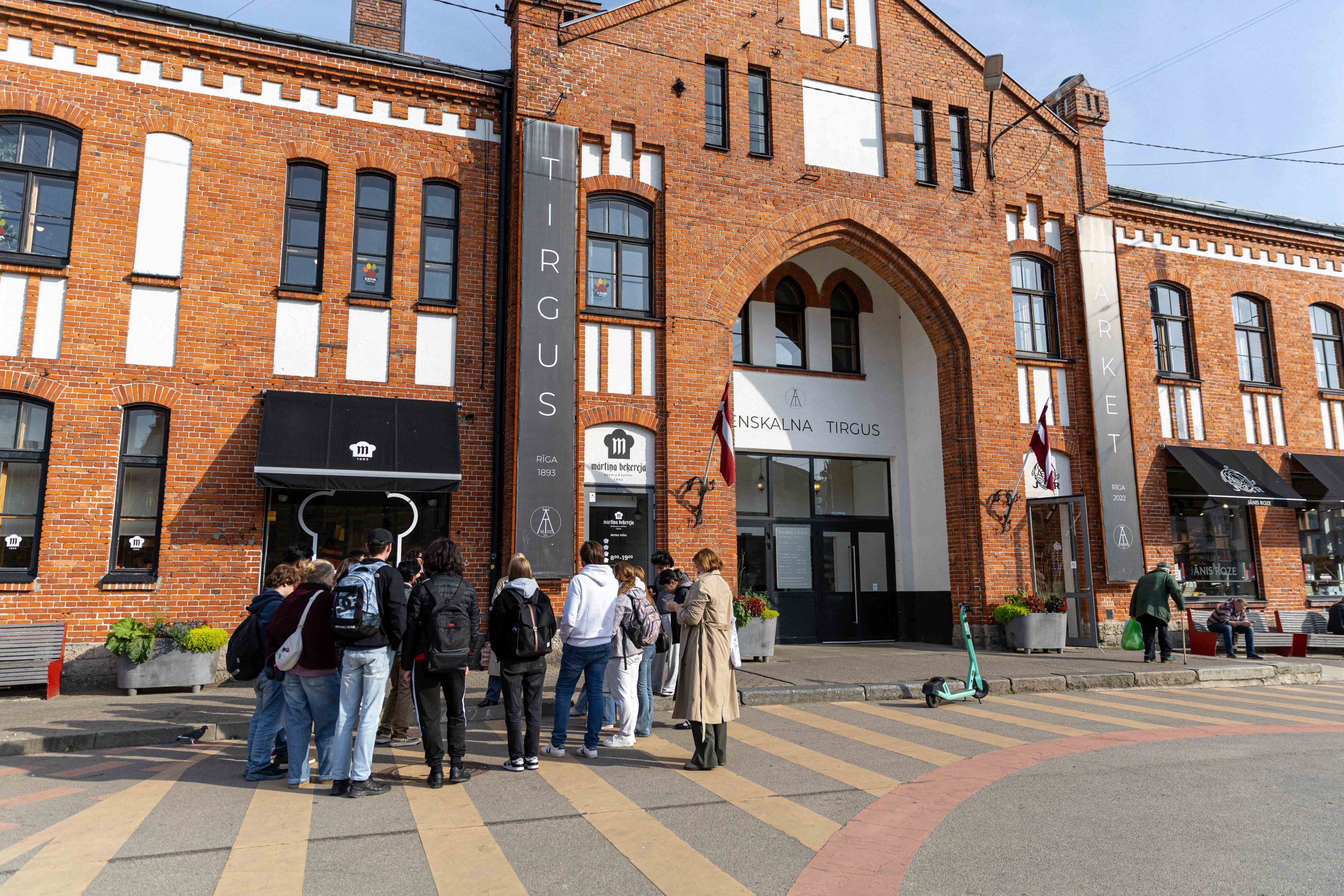
From 5 to 9 October, the Latvian Academy of Culture (LAC) hosted the international ACE²-EU European University Alliance microlearning programme “Taste of Culture: Cultural Heritage in Transition”, bringing together 30 students from nine partner universities to explore creative approaches to preserving and revitalising gastronomic cultural heritage. The programme centred on the development of Vidzeme Market in Riga, challenging students to explore ways of strengthening its identity, attracting new audiences and transforming the market into a vibrant urban space and community meeting place.
Although the students represented nine ACE²-EU partner universities, the diversity of their countries of origin and cultural backgrounds extended far beyond the alliance itself. Their different academic experiences, cultural traditions and perspectives enabled the international teams to approach the challenges facing Vidzeme Market from multiple angles, bringing together knowledge and ideas from different parts of the world.
“This programme was particularly valuable because gastronomic heritage offers a way to explore different cultures, narratives of identity, and questions of personal and collective belonging. It was a dynamic and multifaceted programme that successfully combined cultural heritage studies, creative tourism, social media and digital content creation, regional entrepreneurship and collaboration with industry partners. Together, these elements provided an almost 360-degree perspective on food as part of cultural heritage. What made the experience especially meaningful was the opportunity for students to apply knowledge and skills from their own fields of study – ranging from technology and medicine to information technology and intercultural communication. Bringing these diverse experiences together opened up new perspectives on the future development of Vidzeme Market, while also addressing a broader question: how can culture become a force that brings people together in today’s world?” emphasises Lolita Ozoliņa, Lecturer at the Latvian Academy of Culture and Programme Coordinator.
Over five days, students explored Latvia’s gastronomic cultural heritage, the principles of placemaking, cultural heritage branding, gastronomic storytelling and opportunities for sustainable tourism. The programme combined expert lectures, creative workshops, hands-on urban exploration and meetings with industry professionals.
Gastronomic heritage researcher Astra Spalvēna introduced students to the history of Latvian food culture, while digital content creator and food blogger Madara Martinsone explored gastronomic storytelling on social media from an international perspective. Tourism expert Edgars Ražinskis examined the potential of local markets in the development of slow tourism. Students visited Vidzeme Market and Āgenskalns Market, explored the relationship between traditional gastronomy and culture at Folkklubs ALA, and gained insights into creative entrepreneurship in rural areas through a meeting with Marta Vētra, a representative of the LAUX initiative.
Students drew on the knowledge and experiences gained throughout the programme to develop creative proposals for Vidzeme Market in international teams. On 9 October, the final day of the programme, the teams presented their ideas to a panel of experts.
Their proposals offered a wide range of perspectives on the market’s future – from developing a renewed place identity and communication strategy to transforming the market into a vibrant cultural and community hub. Ideas included gastronomic festivals, concerts, creative workshops, open-air cinema evenings, recreational spaces and new opportunities for local vendors. Students also proposed digital solutions to encourage public engagement and new models of collaboration that could help preserve the market’s cultural and historical identity while attracting new audiences.
The final presentations stood out for their diversity of ideas and fresh perspectives on the development potential of Vidzeme Market. Both external partners involved in the programme highlighted the students’ ability to look at a familiar urban environment from new angles and propose unconventional solutions.
“What surprised me most was the diversity of the young professionals taking part in the programme. Their ideas were innovative, varied and quite different from the approaches we are used to. Perhaps some of them will even influence the future development of Vidzeme Market,” says Kristaps Linkēvics, Operations Manager of Vidzeme Market and Royal SPA & Hotel Resort.
“Taking part in an academic project pushed me outside my usual comfort zone. It was fascinating to see the students’ enthusiasm and how differently each group approached the same place. Every team noticed different details and chose its own focus. The students also brought perspectives shaped by their home countries, lifestyles and cultural backgrounds, allowing us to see a familiar environment in an entirely new light,” says influencer and food blogger Madara Martinsone (@madara.martini).
Participants particularly appreciated the opportunity to collaborate in international and interdisciplinary teams, combining knowledge from different fields of study with practical experience and real-world problem-solving.
“This programme was extremely valuable because it helped us develop our problem-solving skills and work in teams with people from different educational and professional backgrounds. We came up with many good ideas, some of which would be relatively easy to implement. I hope our collective work will contribute to finding solutions to real challenges,” says Hugo, an Agricultural Engineering student from Portugal.
“I think the programme offered an excellent balance between classroom sessions and practical work in the city – meeting people, listening to their perspectives and receiving feedback on our ideas. I would really love to return to Riga one day and see that one of our proposals has actually been implemented at Vidzeme Market,” says Kunal Patil, a Master’s student in Technology Management from Germany.
The programme was jointly organised by the Latvian Academy of Culture, Universidad Francisco de Vitoria in Spain and the Polytechnic University of Santarém in Portugal. It was designed as an Applied Blended Challenge (ABC) – a challenge-based learning format combining online sessions, in-person collaboration in international teams and engagement with real-world industry partners.
The programme is part of the ACE²-EU European University Alliance initiatives aimed at fostering interdisciplinary, international and practice-oriented higher education.
Funded by the European Union. Views and opinions expressed are, however, those of the author(s) only and do not necessarily reflect those of the European Union or the European Education and Culture Executive Agency (EACEA). Neither the European Union nor EACEA can be held responsible for them. Project No. 101177596.