
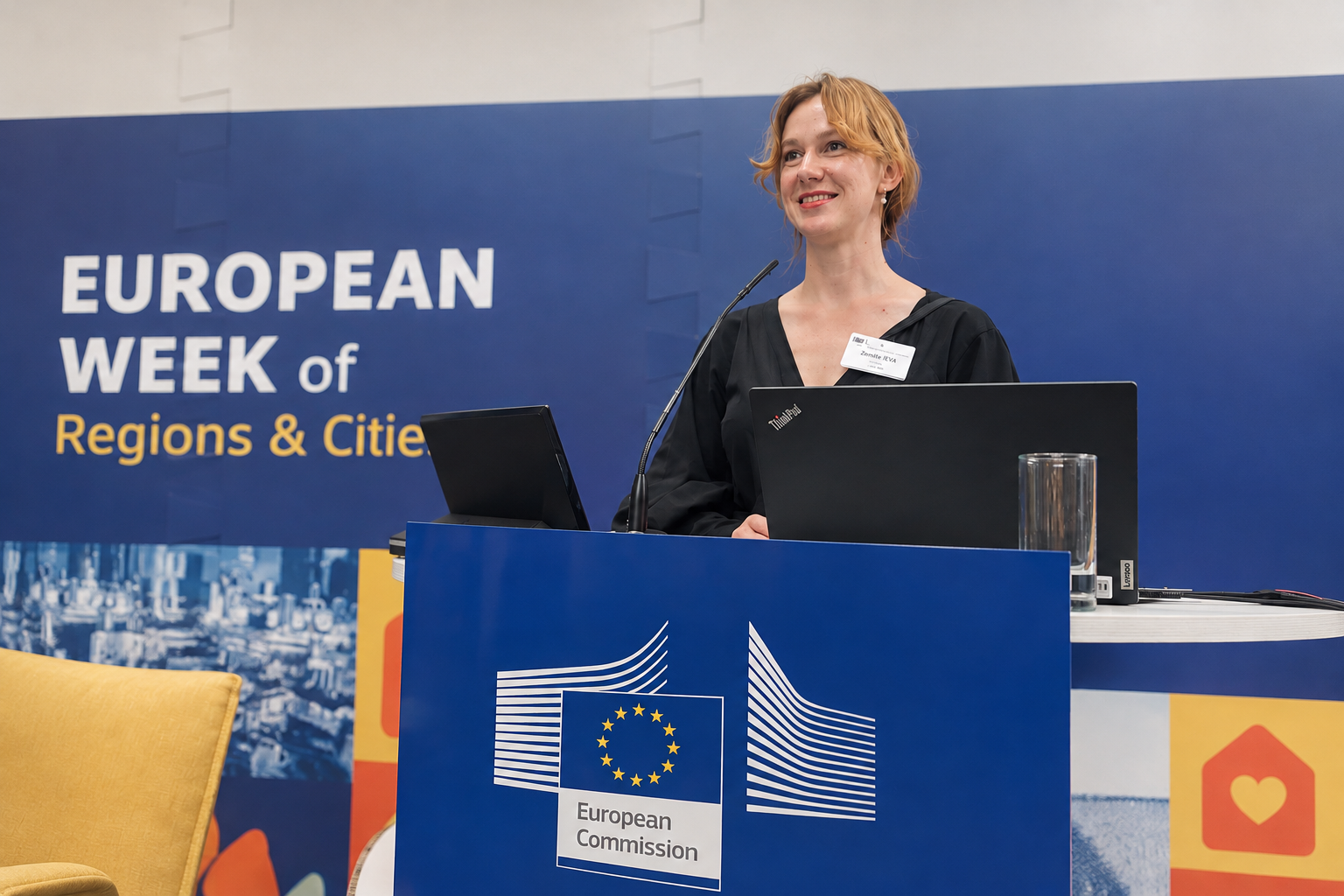
Research insights from the ACE²-EU European University Alliance were brought into a European Commission policy discussion on gender equality, social progress and regional development in Brussels on 13 October 2026. Ieva Zemīte, Associate Professor and Leading Researcher at the Latvian Academy of Culture (LAC), shared findings from a gender equality and social well-being analysis conducted across the Alliance’s nine partner universities, highlighting the importance of inclusive institutional environments and equal opportunities for professional development.
The discussion, “Women Driving Regions Forward: Achievement, Innovation and Social Progress”, was organised by the European Commission’s Joint Research Centre (JRC) as part of the European Week of Regions and Cities satellite event “Crossing Borders, Closing Gaps: New Evidence on Housing and Gender Equality across EU Regions”.
The event brought together researchers and policy experts to explore how evidence can support more effective, place-based policies addressing regional disparities, gender equality and social progress across Europe. One of the central questions was why women’s strong educational achievements do not always translate into equal opportunities in professional careers, leadership, entrepreneurship and innovation.
JRC researchers Petra Krylova and Milene Tessarin presented evidence from the Female Achievement Index, illustrating substantial differences in women’s achievements across EU regions and a positive relationship between female achievement and regional social progress. The discussion also addressed the declining representation of women at the highest levels of academic and research careers, despite their strong presence in higher education.
ACE²-EU perspectives on gender equality and social well-being
Contributing to this discussion, Ieva Zemīte shared insights from the gender equality and social well-being analysis carried out across the nine ACE²-EU partner universities within the Alliance’s Social Impactors approach. The analysis highlights that formally equal opportunities do not necessarily lead to equitable outcomes. Even seemingly neutral career evaluation criteria may disadvantage individuals when differences in starting conditions, caring responsibilities and non-linear career paths are not adequately considered.
These findings reinforce the importance of looking beyond formal equality towards the everyday institutional conditions that shape people’s opportunities, including social well-being, a sense of belonging, psychological safety and access to support.
By bringing perspectives from different European higher education institutions into the discussion, ACE²-EU contributes to a broader understanding of the challenges and opportunities involved in creating more inclusive academic environments.
Connecting gender equality with regional development
The discussion also explored the contribution of women-led businesses to regional economies, particularly in non-urban areas, and the potential of cultural and creative industries to support more inclusive regional development.
Drawing on research conducted at the Latvian Academy of Culture, including the international project Place-based Innovation of Cultural and Creative Industries in Non-Urban Areas (IN SITU), Ieva Zemīte highlighted the importance of local ecosystems in enabling creative entrepreneurs to develop their activities and gain recognition for the value they create.
The key question is not only what women and creative entrepreneurs can achieve, but also whether the surrounding institutions, networks and support structures enable their contributions to become visible, recognised and sustainable.
The panel brought together JRC quantitative policy analyst Panagiotis Ravanos, European Commission DG Research and Innovation gender equality policy expert Oriane Gilloz, and Michael Green, CEO of the Social Progress Imperative. The discussion was moderated by JRC researchers Petra Krylova and Milene Tessarin.
The participation of ACE²-EU in this European policy dialogue illustrates how research and collaboration across universities can contribute perspectives to discussions beyond academia. It also underlines the importance of connecting gender equality, social well-being and regional development when addressing Europe’s long-term social and economic challenges.
Through its Social Impactors approach, ACE²-EU continues to explore how universities can contribute to more inclusive institutions and communities, linking research-based knowledge with societal challenges.
Funded by the European Union. Views and opinions expressed are, however, those of the author(s) only and do not necessarily reflect those of the European Union or the European Education and Culture Executive Agency (EACEA). Neither the European Union nor EACEA can be held responsible for them. Project No. 101177596.