
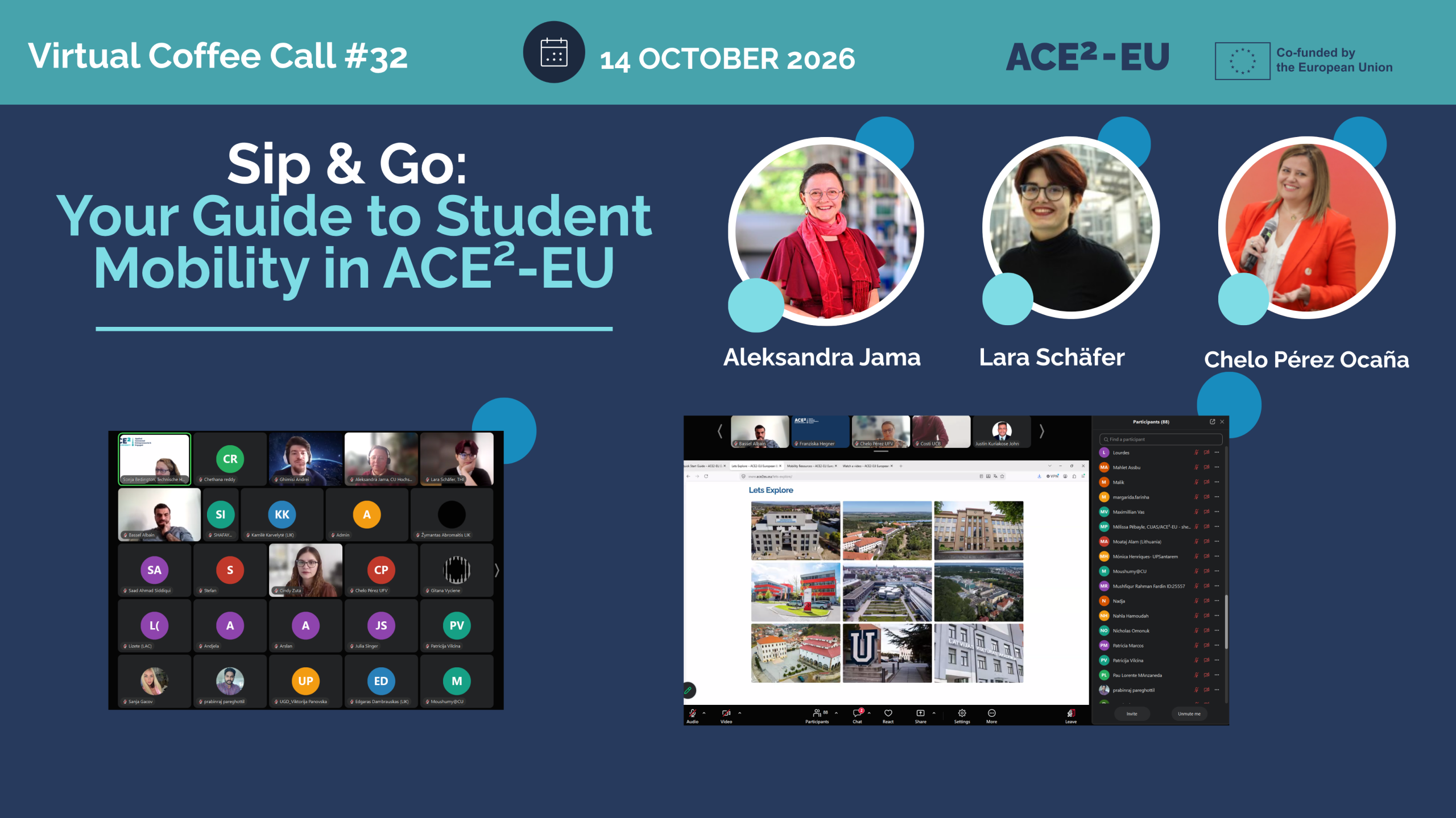
Virtual Coffee #32 focused on student mobility and brought together 119 students for an engaging and informative session about the opportunities available through the ACE²-EU Alliance. The discussion explored the different ways students can gain international learning experiences, while addressing common questions about applications, participation, and practical arrangements. The first part of the session introduced the various student mobility opportunities and answered frequently asked questions, giving students a clearer understanding of how to get involved.
The second session was an introduction to upcoming procedures designed to make mobility management easier and more efficient for both students and administrative staff. The ACE²-EU Alliance offers a wide range of international learning opportunities, helping students develop new skills, collaborate across universities, and address real-world challenges through innovative and experiential learning.
Students can explore short-term mobility opportunities through the central alliance website https://www.ace2eu.eu, by filtering programs by category and date. Available formats include Blended Intensive Programmes (BIPs), Applied Blended Challenge (ABC), Flavor Schools, Impactathons, MOOCs, and COILs.
Application Process
Applications are submitted via Google Forms linked to each program description. A strong motivation letter of 4–5 sentences explaining your interest and learning goals is essential. Successful applicants are typically notified by email within four weeks after the application deadline. Students should also confirm with their home university that they can miss classes to participate. Priority is generally given to students who have not previously participated in mobility activities, particularly ACE²-EU mobilities.
✈️ Funding and Practical Arrangements
A fixed grant is provided for each destination and event to contribute towards travel and accommodation costs. However, students are responsible for arranging their own transport, accommodation, and any required visas. Participants are encouraged to arrive one day before the course begins and leave after the final session.
Attendance, Credits, and Certification
At least 80% attendance is required to receive ECTS credits, and attendance is tracked through daily sign-in sheets. Participants must also provide proof of travel, such as boarding passes or train tickets. Certificates are issued by the host institution and signed by its rector, while recognition of credits depends on the policies of each student’s home university. Accepted students must register on the ACE²-EU Moodle platform using their official university email and complete the compulsory introductory component.
What’s Coming Next?
The ACE Alliance is working on an interactive flipbook catalog to make opportunities easier to explore by month and university. In 2027, a new Moodle-based digital system is expected to streamline student data management and make certification faster and more efficient.
The key message: Plan ahead, write a strong motivation letter, check your university’s requirements, and make the most of the international learning opportunities offered by the ACE²-EU Alliance