Loading Events

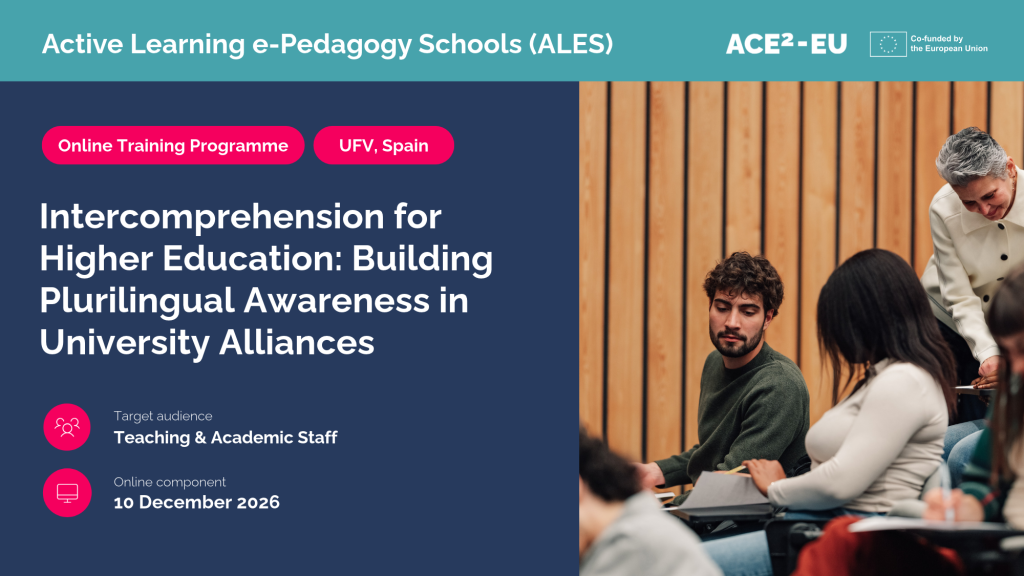
ALES – Intercomprehension for Higher Education: Building Plurilingual Awareness in University Alliances

10 December 2026 @ 3:00 pm - 5:00 pm

🎓 Course Type: ALES
📅 10 December 2026, 3:00 pm – 5:00 pm (UTC+1)
💻 2 hours synchronous online, fully online
📝 Certificate of attendance (no ECTS credits)
🏛️ Universidad Francisco de Vitoria (Spain)
⏰ Application deadline: 10 December 2026, 2:00 pm (UTC+1)

This short online workshop introduces intercomprehension: an approach that allows speakers of different, often related, languages to understand one another by building on what they already know, without needing to be fluent in each other’s language.

Through guided reflection on your own linguistic biography and a hands-on practical activity – including a final part delivered in intercomprehension-oriented Spanish – you will experience intercomprehension live, and discover how plurilingual awareness can support communication, collaboration and inclusion in multilingual university alliances such as ACE²-EU. No previous knowledge of intercomprehension or of Spanish is required.

Application deadline

00
Days
00
Hours
00
Minutes
00
Seconds

Course components and contact hours: 2 hrs synchronous online (interactive workshop combining short input, guided reflection and hands-on practical activities). No independent or group work is required.

Online component: 10 December 2026 (Thursday), 3:00 pm – 5:00 pm (UTC+1).

On-site component: Not applicable – the course is delivered fully online.

On successful completion of the course participants will receive a certificate of attendance (no ECTS credits are awarded for this course).

Universidad Francisco de Vitoria (UFV) (Spain) – Lead and Host Institution

Sarah Mantegna – responsible instructor (UFV)

External stakeholders that will be involved in the course: Not applicable

The course is delivered as a single two-hour interactive online workshop, structured as follows:

  • Online sessions: The session opens with a short, informal moment of awareness-raising on multilingualism and plurilingualism, based on participants’ own everyday experience of moving between languages. It continues with a guided linguistic biography activity, in which participants map their language-learning trajectories and the partial competences they already rely on to communicate. The session then moves into a hands-on intercomprehension activity with texts and exchanges in related languages, during which the facilitator gradually shifts delivery towards intercomprehension-oriented Spanish (interproduction), so that participants experience live how much can be understood by drawing on their own linguistic repertoire. Date: 10 December 2026, 3:00 pm – 5:00 pm (UTC+1).
  • Onsite sessions: Not applicable – this course has no physical mobility component and is delivered entirely online.
  • Follow-up / reflection: The workshop closes with a short reflection activity connecting the practical experience back to participants’ own teaching or academic context, followed by an open discussion in which each participant shares one takeaway or one possible application in their own setting. No formal report or follow-up task is required.

Upon completion of this course, participants will be able to:

  • Recognise that plurilingual communication draws primarily on the linguistic knowledge participants already possess, rather than requiring the acquisition of a new language.
  • Reflect on their own linguistic biography as a resource for relating and connecting the languages and varieties they already know.
  • Distinguish between multilingualism and plurilingualism and identify the role of partial competences within their own plurilingual repertoire.
  • Identify how intercomprehension can function both as a support to traditional language learning and as an autonomous strategy for communicating across languages, without necessarily learning them.
  • Experience directly how shared linguistic features (cognates, shared roots, context) can support understanding of an unfamiliar but related language.
  • Recognise the relevance of intercomprehension for collaboration and inclusion within multilingual university alliances.

By the end of the course, participants will be able to:

  • Explain how plurilingual communication builds on participants’ existing linguistic repertoire rather than on learning new languages from scratch.
  • Describe their own linguistic biography and use it to relate and connect the languages and varieties they already know.
  • Distinguish between multilingualism and plurilingualism, and the role of partial competences within a plurilingual repertoire.
  • Explain the dual role of intercomprehension as both a support for classroom language learning and a standalone strategy for cross-language communication.
  • Apply basic intercomprehension strategies to make sense of written or spoken input in an unfamiliar but related language.
  • Reflect critically on how plurilingual awareness and intercomprehension – including the personal and relational competences they foster, such as openness and curiosity – could be integrated into their own teaching, research or professional activities.

This course is designed for teaching and academic staff from ACE²-EU partner universities, from any discipline and any language background, in particular:

  • Lecturers, professors and researchers from all disciplines
  • Academic staff involved in international mobility, collaborative teaching or cross-institutional projects
  • Staff teaching in international classrooms or working in multilingual academic environments

This course may be suitable for those who have an interest in:

  • Plurilingualism and multilingual communication in higher education
  • Intercomprehension as a practical strategy for understanding across related languages
  • Inclusion, internationalisation and collaboration within European university alliances
  • Developing openness and curiosity towards unfamiliar languages and cultures

Recommended Language Level:

  • English B1–B2. This is mandatory, as English is the working language of ACE²-EU courses.
  • No knowledge of Spanish or any other Romance language is required: intercomprehension and interproduction strategies will make the input accessible regardless of participants’ prior exposure to these languages.

Interested applicants should submit their application through the link below:

🔗 Apply here: https://forms.gle/3oXPG2iM7SzCVCmH7

Deadline for receipt of applications: 10 December 2026, 2:00 pm (UTC+1)

For any further information or queries related to the course, please contact:

Sarah Mantegna – responsible instructor (UFV): sarah.mantegna@ufv.es

Categories: