- This event has passed.
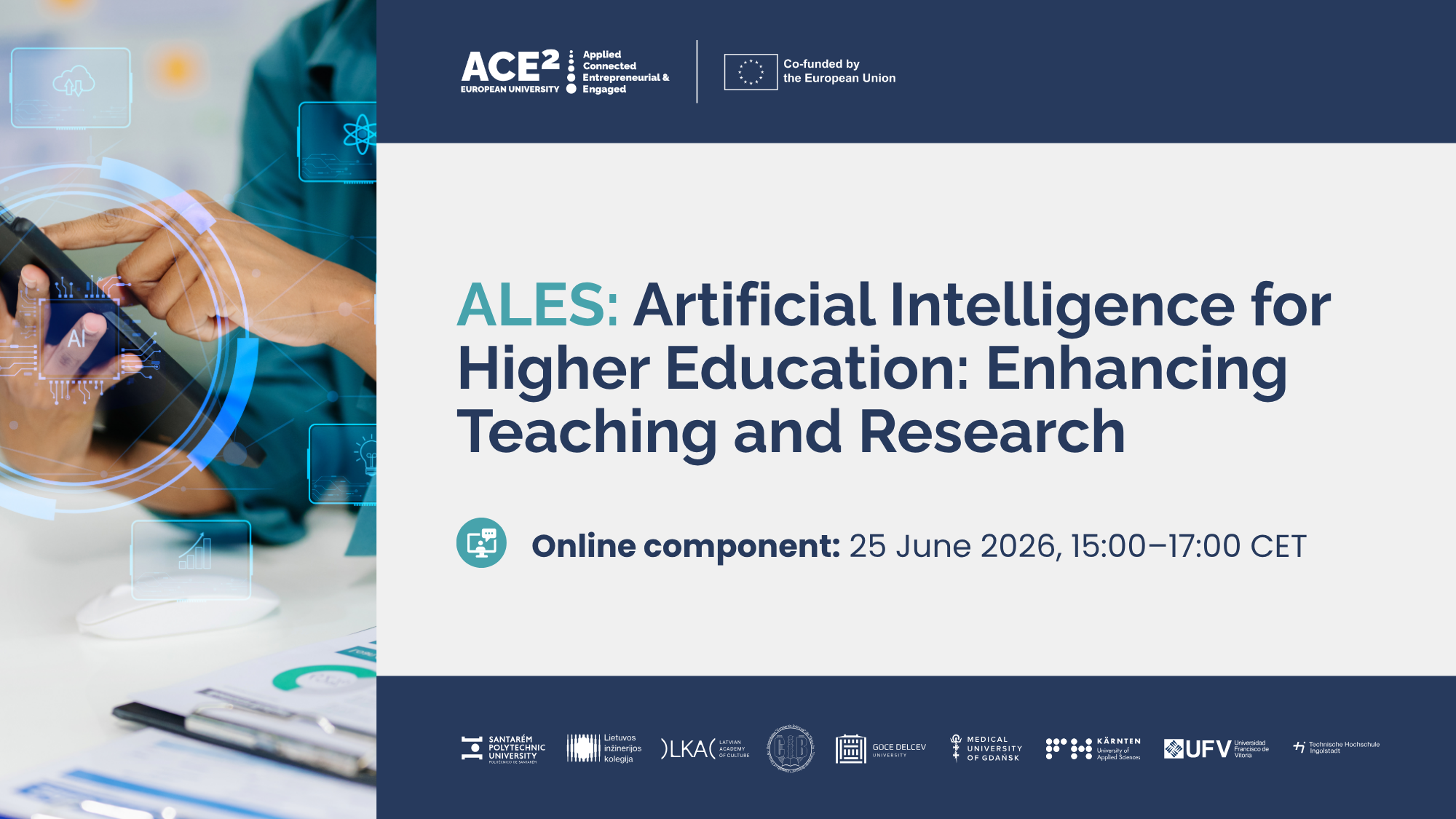
ALES – Artificial Intelligence for Higher Education: Enhancing Teaching and Research
Course Type: ALES
Duration and Learning Format
The course is delivered as a highly interactive online workshop combining short presentations, live demonstrations, hands-on activities, and group discussions.
- Dates of:
- Online component: 25 June 2026 (Thursday), 15:00-17:00 CET
Credits and Certification
On successful completion of the course participants will receive a certificate of attendance
Organising Institutions and Teaching Staff:
Lead and Host Institution
- Goce Delcev University, North Macedonia
- Limonka Koceva Lazarova
Course Overview
Artificial Intelligence is rapidly changing the way we learn, teach, conduct research, and solve problems. However, many students and educators are still unsure how to use AI tools effectively, responsibly, and critically.
This short course introduces participants to practical applications of Artificial Intelligence in higher education. Through real examples and live demonstrations, participants will explore how AI can support learning, teaching, academic writing, literature review, data analysis, and research activities.
The topic is highly relevant because AI technologies are becoming part of everyday academic and professional life across all disciplines. Understanding how to use these tools can improve productivity, creativity, and decision-making while also helping users recognise their limitations and ethical challenges.
No prior knowledge of Artificial Intelligence is required. The course is designed for participants from different academic backgrounds and provides an accessible introduction to AI tools that can be immediately applied in study, teaching, and research contexts.
Learning Journey
- Online sessions:
The learning journey is designed to provide participants with an engaging and practical introduction to the use of Artificial Intelligence in higher education. The online session serves as a collaborative learning environment where participants are guided through key ideas, practical examples, and real-world applications of AI in teaching and research.
Throughout the session, participants are encouraged to actively engage in discussions, reflect on their own experiences, and explore how AI tools can support their academic and professional activities. Demonstrations and interactive activities help participants connect new concepts with their own fields of study and work.
The learning process emphasises exploration, critical thinking, and exchange of perspectives among participants from different academic backgrounds. By the end of the session, participants will have a clearer understanding of the opportunities and challenges of AI and will be able to identify practical ways to integrate AI tools into their learning, teaching, or research practices.
- Follow-up / reflection:
At the end of the workshop, participants will engage in a short reflection activity to consolidate their learning and identify potential applications of AI tools in their own academic context. The reflection will encourage participants to consider both the opportunities and challenges associated with the use of Artificial Intelligence in teaching and research.
The workshop concludes with an open discussion where participants can share ideas, experiences, and examples from their own disciplines. No formal reports or dissemination tasks are required. Learning is consolidated through reflection, peer exchange, and the development of practical ideas that participants can apply in their future academic activities.
Participants will be invited to share one practical AI application they intend to implement in their teaching, learning, or research practice following the workshop.
Learning Objectives
Specific learning objectives include:
Upon completion of this course, participants will be able to:
- Identify the main opportunities and challenges of using Artificial Intelligence in higher education.
- Explore and compare AI tools that support teaching, learning, and research activities.
- Apply selected AI tools to generate educational materials and support academic tasks.
- Analyse how AI can assist literature review, data analysis, and scientific writing processes.
- Reflect on the ethical, academic, and professional implications of AI use in educational and research contexts.
- Discuss and exchange ideas on effective and responsible AI practices with peers from different academic backgrounds.
Learning Outcomes
By the end of the course, participants will be able to:
- Explain the role of Artificial Intelligence in contemporary teaching and research environments.
- Use selected AI tools to support educational and research-related tasks.
- Apply AI-assisted approaches for generating teaching materials, exploring scientific literature, and analysing information.
- Evaluate the benefits and limitations of AI tools in academic contexts.
- Collaborate with participants from diverse disciplines to discuss AI applications and share experiences.
- Reflect critically on the responsible and ethical use of Artificial Intelligence in higher education and research.
Who would find this course useful?
This course is designed for teaching and academic staff from all disciplines who are interested in exploring how Artificial Intelligence can enhance teaching, learning, and research practices. It is particularly relevant for lecturers, professors, researchers, teaching assistants, and academic support staff who wish to improve their productivity, develop innovative teaching approaches, and make more effective use of digital tools in their professional activities.
The course is suitable for participants with diverse academic backgrounds and does not require prior knowledge of Artificial Intelligence, programming, or data science. It offers practical insights and examples that can be applied across a wide range of educational and research contexts.
- Recommended Language Level:
- English B1–B2
This is mandatory, as English is the working language of ACE²-EU courses.
Application Process:
Interested applicants should
🔗 Apply here: https://forms.gle/C861WfyFmqmSF9Gw9
Deadline for receipt of applications: 24 June 2026
Please note that submitting an application does not guarantee a place on the programme. Participating institutions apply their own internal selection procedures.
Prior to the start of the course, selected participants will receive a welcome email from the ACE²-EU Alliance containing detailed information and instructions specific to the programme.
Further Information
For any further information or queries related to the course, please contact:
Email: limonka.lazarova@ugd.edu.mk