

- This event has passed.
Fast Fashion Waste and Cultural Resilience: Rebuilding Sustainable Lifestyles in Times of Global Crisis
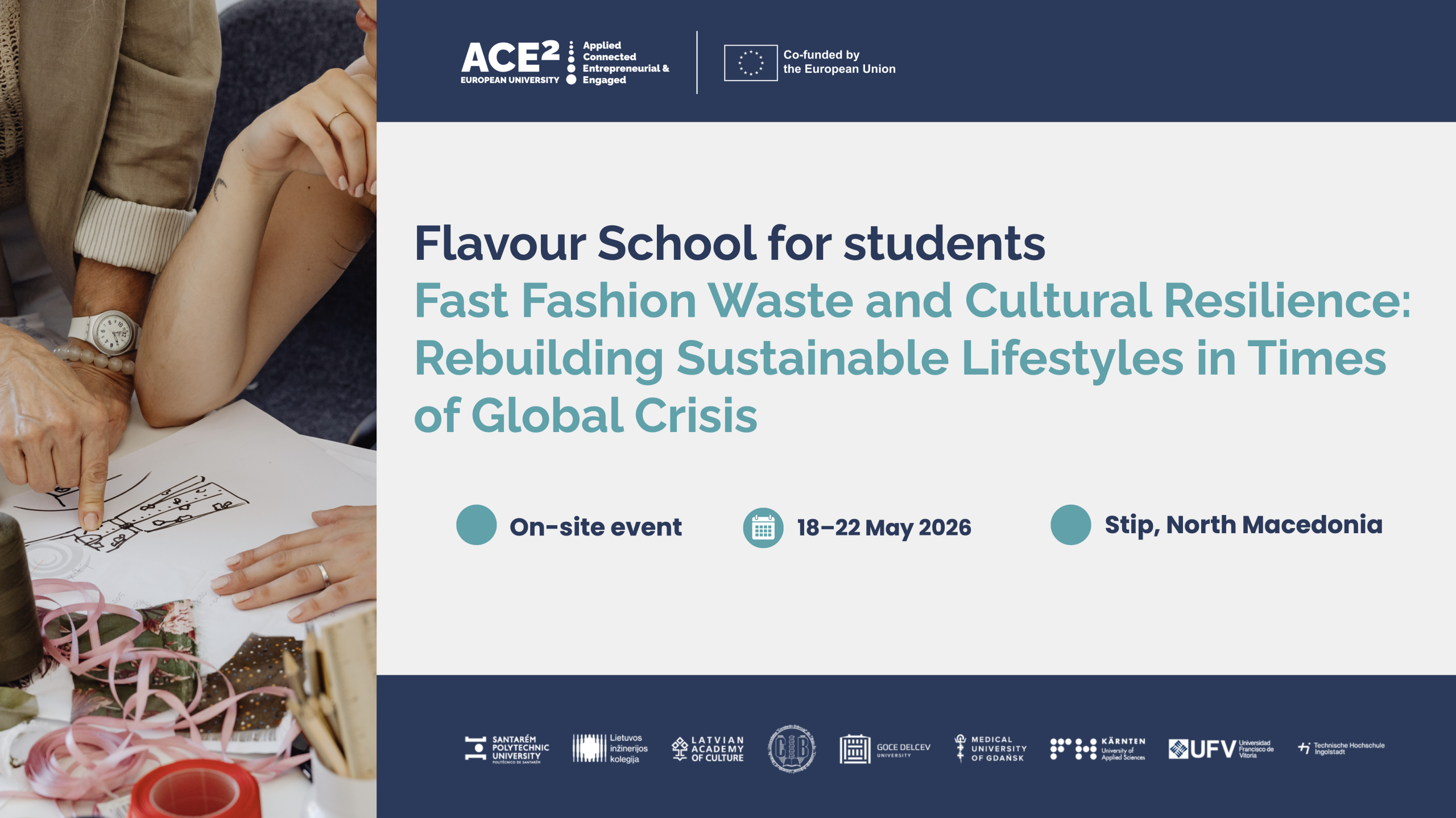
Course Type: Flavour School
This Flavour School is a four-day immersive, challenge-based learning experience designed to foster interdisciplinary collaboration among students from the ACE2EU alliance. The course combines online preparation with intensive on-site activities and hands-on workshops, enabling participants to apply theoretical knowledge to real-world sustainability challenges in the textile and fashion sector. It will be open to students from all ACE2 -EU alliance members.
Duration and Timeline:
Total workload: approximately 50 hours (2 ECTS)
Course components include:
- 20 hours on-site intensive programme
• 25 hours independent and group work
On-site component: 18–22 May 2026
Location: Stip, North Macedonia
Award, Credits and Certification
Upon successful completion of the course, participants will be awarded 2 ECTS credits in accordance with ECTS standards.
Students will also receive an official Certificate of Attendance issued by the host institution within the ACE²-EU framework.
Organised by:
Goce Delcev University – Stip (North Macedonia)
Lead and Host Institution
Academic Team:
Sonja Jordeva
Silvana Zhezhova
Sanja Risteski
Saska Golomeova Longurova
Partner Institution
Universidad Francisco de Vitoria (Spain)
María Isabel Castro Díaz
External stakeholders that will be involved in the course:
The course is developed in collaboration with:
- Municipality of Stip, North Macedonia
• Textile Company DATA TEX LLC, Stip
These stakeholders provide real-life challenges and contextual input for the applied learning activities.
Course Description and Learning Objectives
Course Description:
The course addresses the growing environmental, social and cultural challenges caused by fast fashion and textile waste. It explores how traditional textile knowledge and cultural heritage can serve as powerful tools for building sustainable and resilient lifestyles, particularly in times of global crisis such as climate change, economic instability and social disruption.
Students will engage with key concepts including fast fashion systems, the circular economy, textile waste management, cultural resilience and sustainable design. Through a challenge-based learning approach, participants will collaborate with external stakeholders to analyse real-world problems and co-create innovative, culturally sensitive and environmentally responsible solutions.
Course Structure
The programme is organised into three interconnected phases:
Onsite sessions:
Preparation Phase:
Students are introduced to:
- Fast fashion systems and global supply chains
• Environmental and social impacts of textile waste
• Circular economy principles
• Cultural resilience and heritage-based sustainability
Activities include interactive lectures, readings, case studies and preparatory teamwork.
Practical work
During the mobility period in Stip, students:
- Engage in workshops and stakeholder meetings
• Analyse real-life challenges provided by partners
• Work in interdisciplinary teams
• Develop culturally sensitive and sustainable textile solutions
• Present preliminary concepts for feedback
Follow-up / reflection:
After the on-site phase, students complete:
- Group refinement of solutions
• Reflective assignments linking learning to local or professional contexts
• Final presentations and evaluation
Specific learning objectives include:
By the end of the course, students will have:
- Analyse how textile practices contribute to societal resilience, especially during conflict, displacement, or environmental crisis.
- Evaluate the environmental and social impacts of fast fashion versus sustainable fashion models.
- Apply principles of sustainability to textile design, including the use of natural materials, ethical labour, and circular production methods.
- Collaborate with local artisans or communities to document, preserve, and innovate traditional textile techniques.
By the end of the course, students will be able to:
- Explain the relationship between textile production and global sustainability challenges
• Design culturally rooted and environmentally responsible textile solutions
• Integrate circular economy principles into fashion and design contexts
• Work effectively in interdisciplinary and intercultural teams
• Present solutions grounded in evidence, feasibility and societal impact
Which students would find this course useful for them?
This course may be suitable for students from ACE2-EU partner universities enrolled in undergraduate or postgraduate programs in the following fields:
- Textile and Fashion Design
- Sustainability and Environmental Studies
- Cultural Studies and Heritage
- Social Sciences and related interdisciplinary fields
- Urban Studies and Architecture
- Interested students from any field of study
A multidisciplinary background is encouraged, as collaboration across disciplines is a key component of the learning experience.
Recommended Language Level:
The working language of the course is English. Participants are expected to have a minimum English language proficiency level of B2, enabling active participation in discussions, teamwork, and presentations.
Application Process:
Interested applicants should
🔗 Apply here: https://forms.gle/5BG3wEmTh9Rodj7d6
Deadline for receipt of applications: 20/3/2026
Selection Process:
Each ACE²-EU partner university will select and nominate up to three (3) students to participate in the course.
A notification of acceptance will be sent by each home university to its selected students. Further practical and organisational details will then be provided by the host institution.
Further Information
For any further information or queries related to the course, please contact:
sonja.jordeva@ugd.edu.mk