
maria.lima@esa.ipsantarem.pt

This event has passed.
GREEN BIOECONOMY: Sustainable Food Ingredients — Development of Innovative Food Products from By-products
14 September 2026
@
10:00 am
-
18 September 2026
@
5:00 pm
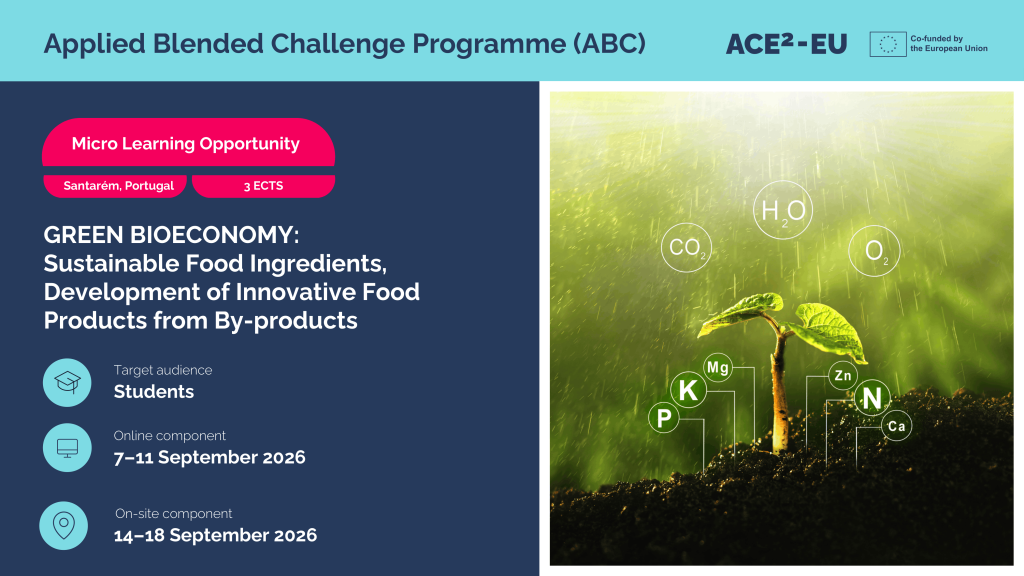
Course Type: Applied Blended Challenge (ABC)
Duration: Total workload 42 hours (12h online + 30h on-site)
Dates: Online component — 7–11 September 2026, 14:00–16:00 CET daily · On-site component — 14–18 September 2026, 10:00–13:00 and 14:00–17:00 daily, IPSantarém — School of Agriculture (ESA), Santarém, Portugal
Credits: 3 ECTS credits and a certificate of attendance
The agri-food industry generates substantial amounts of by-products — fruit and vegetable pomace, peels, seeds and processing residues — alongside underused aquatic biomass such as algae, both rich in nutrients and bioactive compounds yet largely underexploited. This ABC tackles a real-world challenge identified by industry partners: How can stakeholders re-use terrestrial and aquatic biomass as sustainable, safe food ingredients while overcoming technological, regulatory and consumer-acceptance barriers?
Application deadline
00
Days
00
Hours
00
Minutes
00
Seconds
Applications are now closed.
Lead and Host Institution: IPSantarém — School of Agriculture — Maria Gabriela Basto Lima (Lead), Joana Ferreira, Marília Henriques, Ana Teresa Machado Ribeiro, Paula Lúcia Ruivo, João Reis, Patrícia Henriques, Rute Vitor, Vanda Andrade
Partner Institutions: UFV — Universidad Francisco de Vitoria — Estela Pérez Lago, María José Herrero
External stakeholders: colab4food (collaborative laboratory for the food sector — research, innovation and technology transfer); Sumol+Compal (major Portuguese food and beverage company — fruit-processing by-products); Bonduelle (international vegetable-processing leader — vegetable by-products); Club Produtores Sonae (producer network of Sonae retail group — agricultural and retail by-products)
The agri-food industry generates substantial amounts of by-products — fruit and vegetable pomace, peels, seeds and processing residues — alongside underused aquatic biomass such as algae, both rich in nutrients and bioactive compounds yet largely underexploited. This ABC tackles a real-world challenge identified by industry partners: How can stakeholders re-use terrestrial and aquatic biomass as sustainable, safe food ingredients while overcoming technological, regulatory and consumer-acceptance barriers? Working alongside companies in the green- and blue-bioeconomy ecosystem, students apply principles of circular bioeconomy, biorefinery, sustainable extraction and ingredient functionality to design innovative food solutions that meet the growing demand for healthier and environmentally friendly food.
Online component (7–11 September 2026 · 12h, 14:00–16:00 daily), structured in 6 modules of 2 hours each:
Module 1 — Introduction to Green & Blue Bioeconomy: Concepts of circular bioeconomy, sustainability, biomass valorisation and innovation pathways.
Module 2 — Biomass Sources and Bioactive Potential: Agro-industrial by-products, algae and other terrestrial/aquatic biomass; nutritional and functional potential.
Module 3 — Biorefinery and Sustainable Extraction Techniques: Green extraction methods, fractionation strategies and recovery of value-added compounds.
Module 4 — Ingredient Functionality and Food Applications: Technological and functional roles of sustainable ingredients in food systems.
Module 5 — Analytical Methods Overview: Chemical, physical, rheological, microbiological and sensory approaches for ingredient/product evaluation.
Module 6 — Group Work and Challenge Preparation: Team building, stakeholder challenge framing and preparation for the on-site week.
Onsite sessions (14–18 September 2026 · 30h · IPSantarém (ESA)), running 5 full days (10:00–13:00 + 14:00–17:00):
Day 1 — Meet the Stakeholders + Challenge Definition: Raw materials, sustainability context and team project framing.
Day 2 — Extraction / Processing and Ingredient Development: Hands-on work on biomass processing, extraction or ingredient preparation.
Day 3 — Food Product Development: Application of ingredients/extracts in food prototypes or product concepts.
Day 4 — Analytical and Sensory Evaluation + Sustainability Reflection: Product/extract characterisation and discussion of environmental/economic value.
Day 5 — Final Pitches, Showcase & Feedback: Presentation of team solutions to teachers and stakeholders.
Follow-up & reflection: Final team pitch + product/concept prototype delivered to stakeholders. Reflection on environmental and economic implications of converting biomass residues into high-value products. Certificate of attendance issued upon successful participation.
By the end of the course students will be able to:
- Identify sustainable terrestrial and aquatic biomass sources rich in nutrients and bioactive compounds.
- Understand the principles of green and blue bioeconomy, circularity and biorefinery for the valorisation of underused biomass and by-products.
- Evaluate sustainable physical, chemical and biological extraction and processing methods.
- Understand ingredient functionality and its relevance in food formulation and product development.
- Select and apply appropriate analytical methods for the characterisation of biomass, extracts, ingredients and/or developed products.
- Develop innovative food concepts or prototypes using sustainable biomass-derived ingredients.
- Reflect on the environmental and economic implications of converting biomass residues into high-value products.
Level: Undergraduate and postgraduate students from ACE²-EU institutions.
Fields: Food Science and Technology · Biotechnology · Chemistry · Experimental Sciences · Gastronomy · Circular Economy and Sustainable Development · Nutrition and Health Sciences.
Mindset: Motivated to work in multidisciplinary and international teams, applying knowledge to real-world food challenges using sustainable ingredients.
Universities: Open to students from any ACE²-EU partner university.
Language: English B1–B2.
Apply here: https://forms.gle/6DQVYHwUQP1WytZf7
Deadline for receipt of applications: 15 July 2026
Please note that submitting an application does not guarantee a place on the programme. Participating institutions apply their own internal selection procedures. Prior to the start of the course, selected participants will receive a welcome email from the ACE²-EU Alliance containing detailed information and instructions specific to the programme.