
Apply here: https://forms.gle/Ds85gjaX1t57NRcY8
Deadline for receipt of applications: 20 July 2026

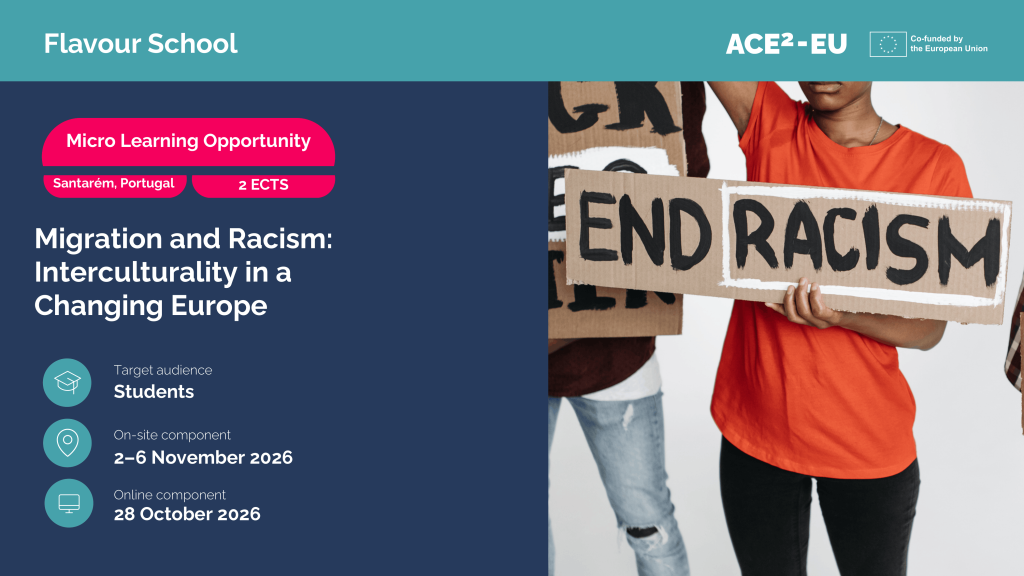
Course Type: Flavour School
Dates: Online — 28 October 2026 · Presential component — 2–6 November 2026, IPSantarém, Portugal
Organized by: Instituto Politécnico de Santarém (Portugal), Medical University of Gdańsk, Carinthia University of Applied Sciences (Austria), University Constantin Brâncusi Târgu-Jiu
How does racialisation shape migrant experiences in today’s Europe — and what tools do students need to engage critically and ethically with these realities? This Flavour School brings together undergraduate and graduate students from across the ACE²-EU Alliance to examine migration, racism and interculturality as intertwined dimensions of contemporary European societies. Through an online launch session and an intensive on-site week at IPSantarém, participants engage with academics, public institutions and migrant-led civil society organisations using active and challenge-based learning, field visits and intercultural teamwork.
Application deadline
Applications are now closed.
Organised by: Instituto Politécnico de Santarém (Portugal) — Lia Pappámikail (lead), Tatiana Ferreira (lead); Medical University of Gdańsk; Carinthia University of Applied Sciences in Austria; University Constantin Brâncusi Târgu-Jiu
External stakeholders:
This Flavour School addresses one of the most urgent challenges facing contemporary European societies: how to live together in increasingly diverse contexts where migration, identity and racism intersect with public policy, civic life and everyday experience. Drawing on sociology, anthropology, law, public policy and intercultural studies, the course invites students to examine how racialisation shapes migrant trajectories, how institutions respond, and how civil society and migrant-led organisations build alternatives. Through field visits, dialogue with practitioners and structured intercultural teamwork, participants develop the analytical, ethical and practical competences needed to act as agents of inclusion in their own academic and community contexts.
Online launch (28 October 2026): Course kick-off and group formation across IPS, MUG, CUAS and UCB. Foundational frameworks: migration, racialisation, interculturality. Briefing on the on-site week and field visits. Synchronous online activities (hours TBC).
On-site sessions (2–6 November 2026 · IPSantarém · 5 days): Workshops on migration policy, anti-racism and intercultural mediation. Field visits and interactions with migrant communities, NGOs and government agencies. Collaborative work with stakeholders (AIMA Migration Observatory, Renovar a Mouraria). Challenge-based teamwork in interdisciplinary, intercultural student groups. Final group presentations and reflective synthesis.
Follow-up & reflection: Reflective essay on critical understanding and personal reflections about migration and racism. Group deliverable from the on-site challenge. Individual reflection on intercultural learning and competences acquired.
By the end of the course, students will be able to:
Level: Undergraduate and graduate students from any ACE²-EU partner university.
Fields: Social Sciences · Sociology · Anthropology · Law · Education · Public Policy · Public Health · Social Work · Communication · Humanities · International Relations · Human Rights.
Suitable for those interested in: Migration · Anti-racism · Interculturality · Civil society engagement · Public policy · Field-based learning · Working in international and intercultural teams.
Language: English B1–B2 (to confirm).
Apply here: https://forms.gle/Ds85gjaX1t57NRcY8
Deadline for receipt of applications: 20 July 2026
ace2eu@ufv.es