Loading Events

« All Events

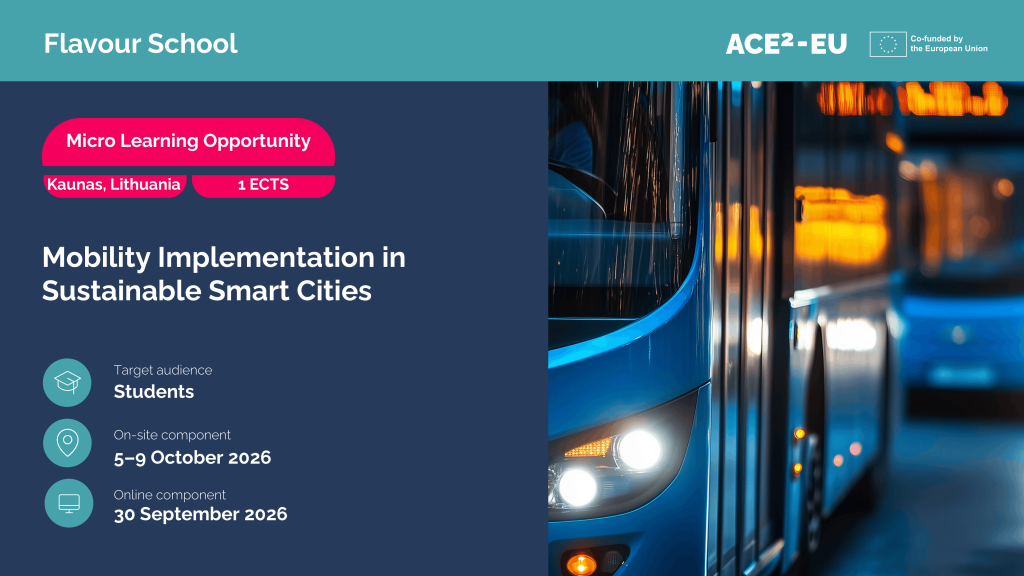
Mobility Implementation in Sustainable Smart Cities

5 October @ 8:00 am - 4:00 pm

Course Type: Flavour School

Duration and Timeline:

  • Course components and contact hours: 35 h on-site
  • On-site component: 05-09 October 2026, place – Kaunas, Lithuania


Award, Credits and Certification

On successful completion of the course participants will receive 1 ECTS credit and a certificate of attendance

Organized by:

Host and lead

Lietuvos inžinerijos kolegija (Lithuania)


  • dr. Tomas Mickevičius
  • dr. Andrius Dargužis
  • dr. Marius Mažeika
  • dr. Giedrė Adomavičienė
  •  Judita Štreimikienė


Partner

Goce Delcev university (North Macedonia)


  • Ekaterina Namiceva Todorovska
  • Marija Hadzi Nikolova
  • Ana Michailovska
  • Daniela Buklioska Ilievska


Stakeholders

Kaunas District Municipality

Transport companies (JSC Kauno autobusai, JSC Adampolis)

 smart solution providers (JSC Elinta)

Science and research institutions (Vytautas Magnus University)

Course Description and Learning Objectives

During the course, students will acquire creative thinking skills that allow them to develop innovative and practical solutions. The course examines how smart and sustainable mobility can be designed and implemented in urban environments to increase climate resilience, environmental safety and social inclusion. During the course students will work in interdisciplinary teams to solve real-world transport mobility challenges presented by external stakeholders. The course integrates knowledge from transport engineering, urban planning, renewable energy, digital technologies and social sciences to create holistic smart city mobility ecosystems.


Course Description:
Day 1: Foundations of Smart and Sustainable Mobility. Activity: Interactive mapping of existing urban mobility challenges in participants’ cities.

Day 2: Technologies and Innovations in Smart Mobility. Activity: Group analysis of a smart city mobility case study.

Day 3: Policy, Governance, and Stakeholder Engagement. Activity: Role-play simulation — city council meeting on adopting a new mobility policy.

Day 4: Designing Integrated and Sustainable Mobility Solutions. Activity: Group project — design a “Smart Mobility Action Plan” for a chosen city or district.

Day 5: Implementation, Monitoring, and Evaluation. Activity: Final presentation and reflective discussion on lessons learned.

Specific learning objectives include:

  • Explain the main principles of smart and sustainable urban mobility
  • Analyse current challenges and trends shaping urban mobility systems
  • Apply digital and data-driven solutions in mobility planning
  • Evaluate different smart mobility models and technologies
  • Evaluate the environmental, social and economic impact of mobility solutions

By the end of the course, students will be able to:

Explain the fundamental principles of sustainable and smart mobility within the context of urban development.

Analyse current challenges, trends, and technologies shaping urban mobility systems.

Evaluate different models of smart transportation systems and their applicability to various urban contexts.

Apply digital tools and data-driven approaches to improve transportation efficiency and sustainability.

Design integrated, people-centred, and environmentally responsible mobility strategies for smart cities.

Collaborate in interdisciplinary teams to develop innovative solutions addressing real-world urban mobility problems.

Assess the environmental, social, and economic impacts of mobility interventions in smart cities.

Which students would find this course useful for them?

This course may be suitable for students from ACE2-EU partner universities enrolled in undergraduate or postgraduate programs in the following fields:

  • Transport and Civil Engineering
  • Architecture and Urban Planning
  • Environmental and Energy Studies
  • Information and Data Technologies
  • Social Sciences and Public Policy
  • Business and Innovation Studies


This course may be suitable for those who have an interest in:

  • Smart cities and sustainable urban development
  • Climate change security
  • Sustainable transport
  • Interdisciplinary teamwork and challenge-based learning

  • Recommended Language Level:
    • Basic to intermediate level of English (B1-B2), as the working language will be English

Application Process:

Interested applicants should provide applications through official

🔗 Apply here: link

Deadline for receipt of applications: 31 August 2026

A notification of acceptance to participate will be sent to successful applicants on the 15 September 2026 (an acceptance letter will be sent by the host institution and will include program registration details)


Further Information

For any further information or queries related to the course, please contact:

judita.streimikiene@lik.tech

Details

Other

Event status
Open for registration
Registration deadline
31 August 2026
Event format
Hybrid
Certificate
Yes
Registration link
https://forms.gle/L1qxaS2Z4sNLt8Gy8
University / Country
LIK / Lithuania