
ace2eu@ufv.es

This event has passed.
Grapes and Health: Exploring the Nutritional and Therapeutic Potential of Their Bioactive Compounds
28 September 2026
-
2 October 2026
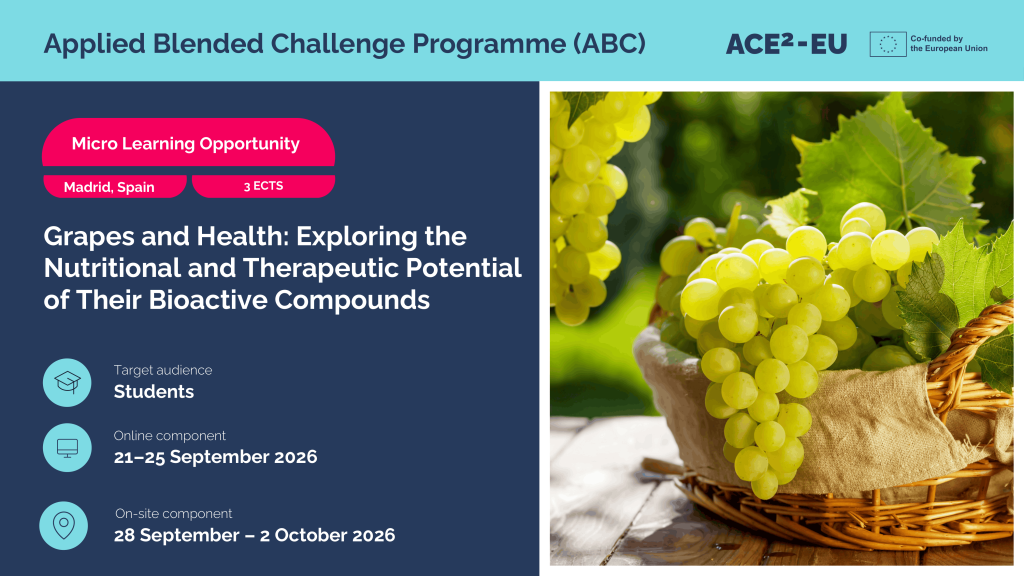
Course Type: Applied Blended Challenge (ABC) Programme
Dates: Online component — 21–25 September 2026 · On-site component — 28 September – 2 October 2026
Credits: 3 ECTS credits and a certificate of attendance
Grapes (Vitis vinifera) and their by-products are among the most studied sources of bioactive compounds in food and health science — from polyphenols and flavonoids to resveratrol, anthocyanins and tannins. This ABC tackles the real-world challenge identified by the Virgen de la Viña winery and partners: how to identify and assess the beneficial effects of grape compounds, and translate that evidence into practical applications.
Application deadline
00
Days
00
Hours
00
Minutes
00
Seconds
Applications are now closed.
Universidad Francisco de Vitoria · Pozuelo de Alarcón, Madrid — María José Herrero & Estela Pérez Lago
Santarém Polytechnic University — Joana Ferreira · Patrícia Henriques · Gabriela Basto Lima · João Reis
Goce Delcev University
External stakeholders: Virgen de la Viña (winery)
Grapes (Vitis vinifera) and their by-products are among the most studied sources of bioactive compounds in food and health science — from polyphenols and flavonoids to resveratrol, anthocyanins and tannins. These compounds have demonstrated effects on cardiovascular, neurological, digestive and immunological systems, with growing applications in functional foods, nutraceuticals and preventive medicine. This ABC tackles the real-world challenge identified by the Virgen de la Viña winery and partners: how to identify and assess the beneficial effects of grape compounds, and translate that evidence into practical applications. Working in international, transdisciplinary teams across biotechnology, biomedicine, nutrition and food science, students develop evidence-based proposals that bridge phytochemistry, molecular pharmacology, agronomic processing and nutritional intervention.
Online sessions (21–25 September 2026 · 5 days): Foundations of grape phytochemistry: polyphenols, flavonoids, tannins, resveratrol. Scientific evidence on the beneficial effects of grape compounds across physiological systems (cardiovascular, neurological, digestive, immunological). Molecular mechanisms of action of grape bioactives. International team formation, stakeholder briefing (Virgen de la Viña), challenge framing.
On-site sessions (28 September – 2 October 2026 · UFV Madrid · 30 hours): Dialogic expository sessions linking phytochemistry, biomedicine and nutrition. Practical laboratory sessions — extraction, characterisation and analysis of grape bioactives. Visit and engagement with the Virgen de la Viña winery — agronomic conditions, processing. Collaborative project-based teamwork in transdisciplinary international groups. Final presentation of strategies for practical application (functional nutrition / nutraceuticals / functional foods).
Follow-up / reflection: Reflective learning logs across the two weeks. Final group deliverable: strategy for practical application of grape bioactives in functional nutrition, nutraceutical formulation or food product development. Individual reflection on transdisciplinary learning.
- Analyse the phytochemical composition of grapes and grape pomace, with special emphasis on polyphenols, flavonoids, tannins and resveratrol.
- Evaluate the scientific evidence on the beneficial effects of grape compounds on different physiological systems (cardiovascular, neurological, digestive, immunological, among others).
- Understand the molecular mechanisms of action of the main bioactive compounds in grapes.
- Examine the impact of industrial processing and agronomic conditions on the bioactivity and bioavailability of grape compounds.
- Design strategies for the practical application of grape bioactive compounds in contexts such as functional nutrition, the formulation of nutraceuticals or the development of foods with health properties.
Level: Undergraduate and postgraduate students from any ACE²-EU partner university.
Fields: Biotechnology · Biomedicine · Nutrition · Food Science — also welcome: Pharmacy · Biology · Chemistry · Health Sciences · Oenology.
Suitable for those interested in: Functional foods · Phytochemistry · Preventive nutrition · Nutraceuticals · Wine industry · Translational research · Industry-academia collaboration.
Universities: Open to students from any ACE²-EU partner university.
Language: English B1–B2.
Apply here: https://forms.gle/Aqf79wEPxGWnKDF1A
Deadline for receipt of applications: 15 July 2026
Please note that submitting an application does not guarantee a place on the programme. Participating institutions apply their own internal selection procedures. Prior to the start of the course, selected participants will receive a welcome email from the ACE²-EU Alliance containing detailed information and instructions specific to the programme.