

ALES Gamification for Teaching and Learning in Higher Education
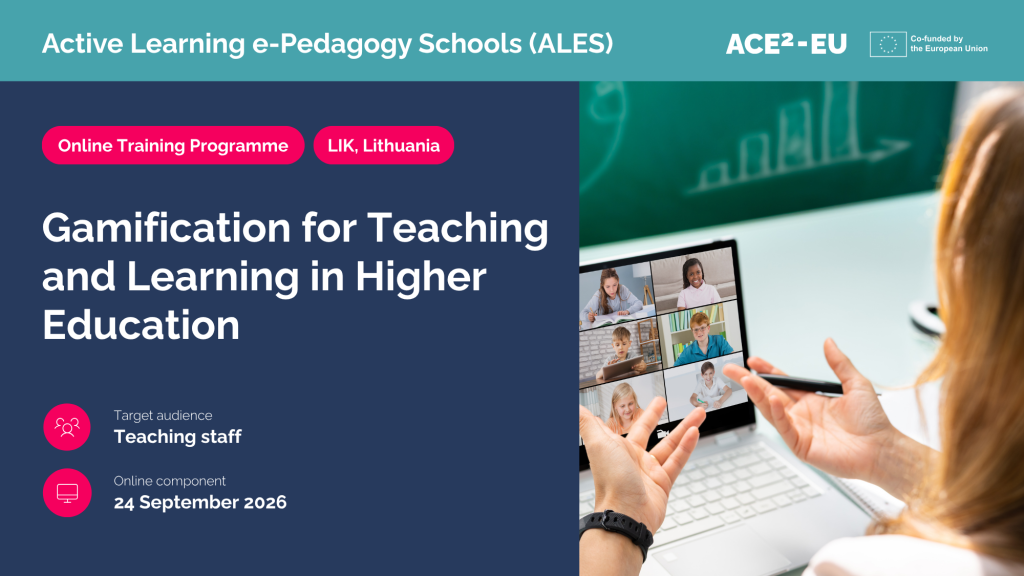
Course Type: Active Learning e-Pedagogy Schools (ALES)
Duration: 2 hrs. synchronous online activities
Dates: Online component — 24 September 2026, 15:00–17:00 CET
Certification: Official certificate of attendance
Gamification is everywhere in higher education right now: points, badges, leaderboards, quests. But does it work? The honest answer: it depends entirely on how thoughtfully it’s designed. Recent research shows gamified teaching reliably lifts motivation and engagement. However, its impact on genuine learning remains unpredictable; courses designed without a clear understanding of how motivation operates often fail, regardless of their game-like appearance.
Application deadline
Applications are now closed.
Lead and Host Institution: Lietuvos inžinerijos kolegija (Lithuania) — Dovile Valantiejiene, PhD
Gamification is everywhere in higher education right now: points, badges, leaderboards, quests. But does it work? The honest answer: it depends entirely on how thoughtfully it’s designed. Recent research shows gamified teaching reliably lifts motivation and engagement. However, its impact on genuine learning remains unpredictable; courses designed without a clear understanding of how motivation operates often fail, regardless of their game-like appearance.
Two hours won’t turn anyone into a game designer, and this session doesn’t pretend otherwise. By the end, participants will have a clearer sense of what makes a learning activity, assignment, or feedback-and-assessment moment feel motivating rather than merely being decorated with game elements. Also, why so many well-intentioned attempts quietly backfire, including rewards that undermine students’ own interest in the material. Participants will leave with a simple way to judge whether a design choice will help or hurt, both for individual students and for groups working together, as well as a few concrete starting points worth experimenting with in their own teaching. It is designed for educators from all disciplines and requires no prior expertise in gamification or game design.
- Understand what makes gamification effective in higher education.
- Recognise the difference between meaningful gamification and the simple use of points, badges, or leaderboards.
- Identify common gamification mistakes that can reduce student motivation.
- Apply basic gamification principles to their own teaching activities.
- Reflect on how gamification can support student engagement and learning.
- Develop an initial idea for using gamification in their own course or learning activity.
By the end of the course, participants will be able to:
- Explain the core psychological and design principles behind effective gamification, and their relevance to teaching and learning in higher education.
- Apply gamification in the practical context of learning activities, assignments and feedback or assessment moments.
- Critically evaluate gamification choices, identifying design pitfalls that undermine intrinsic motivation, exclude some learners, or lack a clear theoretical grounding.
- Sketch an initial idea for their own teaching context, to develop and try out further after the course.
This course is designed for teaching staff from ACE²-EU partner universities across all disciplines who want to move beyond superficial gamification techniques toward evidence-based, motivation-focused design. It is particularly suitable for educators seeking to strengthen student engagement and reflect critically on when and why to introduce gamification into their teaching.
Apply here: https://forms.gle/BJs5gq7UsKo2D2Qh7
Deadline for receipt of applications: 24 September 2026
A Microsoft Teams calendar invitation will be sent to all registered teaching staff.