Loading Events

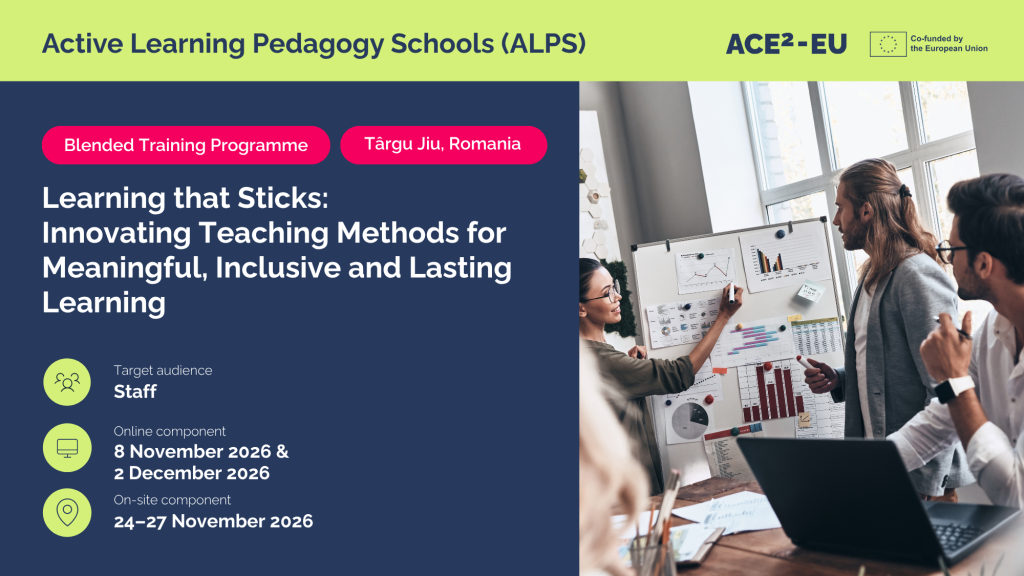
Learning that Sticks: Innovating Teaching Methods for Meaningful, Inclusive and Lasting Learning

24 November 2026 - 27 November 2026

Course Type: Active Learning Pedagogy School (ALPS) — Staff Training Programme
Duration: Online preparatory — 2h · On-site — 32h (4 days) · Online follow-up — 2h · Independent reflection and follow-up work — 20h
Dates: Online preparatory — 18 November 2026, 12:00–14:00 CET · On-site — 24–27 November 2026, Târgu Jiu, Romania · Online follow-up — 2 December 2026, 12:00–14:00 CET
Credits: 2 ECTS credits and a certificate of attendance

Teaching today is not only about delivering content well; it is about helping students to engage with, remember and actually use what they learn. The Active Learning Pedagogy School (ALPS) addresses a key question in higher education: how can university teachers design learning experiences that are meaningful, inclusive and lasting?

Application deadline

00
Days
00
Hours
00
Minutes
00
Seconds

Lead and Host Institution: “Constantin Brâncuși” University of Târgu Jiu (UCB) — Andreea Mihaela Cilibiu, PhD, Lecturer (Course Coordinator); Cătălin-Ionuț Drăgan, PhD candidate; Elena Paliță, PhD, Lecturer; Mihaela Manasia, PhD, Lecturer; Loredana Pătrașcoiu, PhD, Lecturer; Mihaela Giurgiulescu, PhD, Lecturer; Camelia-Daniela Plăstoi, PhD, Professor

External stakeholders: Simona Maria Stănescu — Research Institute for Quality of Life (ICCV), Senior Researcher I and Doctoral Supervisor; Dragoș Drumen — Youth for Sustainable Development Association (Asociația Tineret pentru Dezvoltare Durabilă / ATDD)

Teaching today is not only about delivering content well; it is about helping students to engage with, remember and actually use what they learn. Learning becomes lasting when students investigate, create, collaborate, play, reflect, receive meaningful feedback and connect new knowledge with real experiences.

The Active Learning Pedagogy School (ALPS) addresses a key question in higher education: how can university teachers design learning experiences that are meaningful, inclusive and lasting? Rather than offering a collection of isolated techniques, the programme treats active learning as a coherent process of experiencing, reflecting, redesigning, testing and transferring.

Participants will first experience a range of methods as learners — including research-based learning, storytelling, World Café, Universal Design for Learning (UDL), multimodal and tactile learning, game-based learning, digital pedagogy and non-formal education — and will then analyse why these methods work and how they can be applied in their own disciplines. Each participant brings a real course or teaching challenge to rethink and, from Day 2 onwards, works in an interdisciplinary and intercultural team to co-create and pilot a new Short Learning Opportunity (SLO).

Reflection is supported throughout by a Learning Diary, the Sticky Wall, a shared digital portfolio and the individual Learning that Sticks Passport.

Online sessions: The programme begins with a short online preparatory session (18 November 2026, 12:00–14:00 CET), where participants are introduced to the overall approach and the blended learning journey, connect with peers and reflect on their current teaching practice. Each participant selects one real course sequence, topic or teaching challenge to work on during the programme.

On-site sessions (Târgu Jiu, Romania, 24–27 November 2026):

Day 1 — Connection & Challenge
Day 2 — Experiencing the Challenge & Mapping the Needs
Day 3 — Teamwork & Co-creation
Day 4 — Piloting & ACE Teacher Persona

Working in interdisciplinary and intercultural teams, participants will design, test and refine a new shared SLO, which is piloted through microteaching and peer feedback on the final day.

Learning also takes place beyond the classroom: the Brâncuși Learning Quest: From Silence to Infinity is a team-based challenge following the route from the Table of Silence to the Endless Column, turning the city into an experiential learning environment. An intercultural evening — Taste & Wear the Tradition: A Gorj Cultural Experience — brings together local gastronomy, traditional costume and intercultural exchange. Accessible and weather-appropriate alternatives will be provided wherever needed.

Follow-up / reflection: The programme concludes with an online follow-up session (2 December 2026, 12:00–14:00 CET), where participants engage in guided reflection and peer exchange, each sharing one concrete step for transferring the ALPS experience to their own teaching.

  • To understand and experience the principles of active-experiential learning in higher education through concrete methods.
  • To connect research-based learning, storytelling, UDL, multimodal and tactile learning, game-based learning, digital pedagogy and non-formal methods with clear learning purposes.
  • To analyse current teaching practices and identify methods that can realistically be transferred to participants’ own disciplinary contexts.
  • To design inclusive, student-centred learning activities that take learner variability into account.
  • To co-create a new interdisciplinary and intercultural Short Learning Opportunity (SLO) through teamwork, prototyping and peer feedback.
  • To pilot, assess and refine the shared SLO, and to reflect on the teacher’s role as facilitator, designer, co-creator and ACE²-EU ambassador.

By the end of the course, participants will be able to:

  • Explain the key principles of active, experiential, meaningful and lasting learning in higher education.
  • Adapt selected research-based, storytelling, inclusive, game-based, digital and non-formal methods to their own disciplinary teaching.
  • Apply UDL and multimodal design principles to strengthen participation and access for diverse learners.
  • Distinguish between individual course redesign and collaborative SLO co-creation, and contribute effectively to both.
  • Co-create, prototype and pilot a new interdisciplinary and intercultural SLO using student-centred, pedagogically coherent methods.
  • Use peer feedback and assessment evidence to refine their active-learning designs.
  • Identify concrete methods to transfer into their own teaching and articulate their developing ACE Teacher Persona.

This course is suitable for academic and teaching staff from ACE²-EU partner universities involved in undergraduate and postgraduate education.

It is particularly relevant for participants from all academic disciplines who are interested in enhancing their teaching practice, especially those who will design or deliver Short Learning Opportunities (SLOs), Micro-Learning Opportunities (MLOs), joint ACE²-EU programmes or other collaborative educational formats.

This course may be suitable for those who have an interest in: Active, experiential and challenge-based learning · Research-based learning and inquiry · Storytelling and meaningful learning design · Universal Design for Learning (UDL), inclusive and multimodal/tactile learning · Game-based learning and non-formal education · Digital pedagogy and collaborative learning tools · Intercultural teamwork, co-creation and SLO design · Peer feedback, assessment for learning, reflection and teacher facilitation.

Requested Language Level: English B1–B2. This is mandatory, as English is the working language of ACE²-EU courses.

Interested applicants should apply through their home institution within the ACE²-EU Alliance.

Apply here: https://forms.gle/KMZNiFtRYFt8V7A19

Deadline for receipt of applications: 24 October 2026

Please note that submitting an application does not guarantee a place on the programme. Participating institutions apply their own internal selection procedures. Prior to the start of the course, selected participants will receive a welcome email from the ACE²-EU Alliance containing detailed information and instructions specific to the programme.

Categories: