
ace2eu@ufv.es

Cultural Communication in VR
23 November 2026
-
27 November 2026
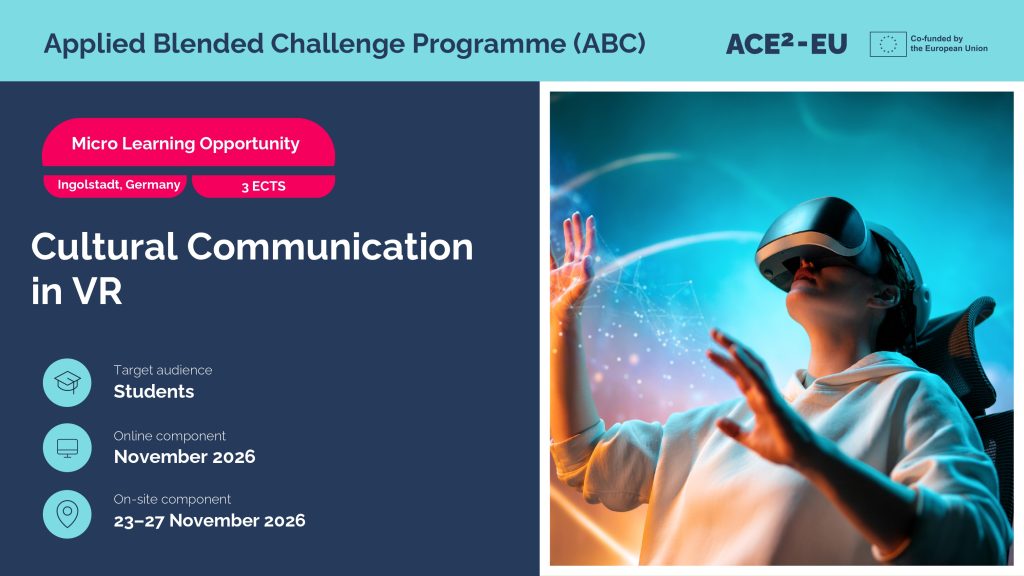
Course Type: Applied Blended Challenge (ABC) Programme
Dates: Online component — October–November 2026 · On-site component — 23–27 November 2026
Credits: 3 ECTS credits and a certificate of attendance
Virtual Reality is no longer just a technology of entertainment — it is becoming a medium for empathy, learning and cross-cultural encounter. This ABC asks students to go beyond consuming VR to designing it — drawing on cultural communication theory, visual storytelling and human-centred design to create immersive experiences that translate cultural specificity into embodied understanding.
Application deadline
00
Days
00
Hours
00
Minutes
00
Seconds
Applications are now closed.
Organised by: Technische Hochschule Ingolstadt, Germany; Latvian Academy of Culture, Latvia; Carinthia University of Applied Sciences in Austria
External stakeholders: VR companies and tech partners (loan of equipment, technical mentoring, industry perspectives on immersive media); Museums and cultural institutions (real-world VR use cases for cultural heritage, visits and case studies); Intercultural / migrant organisations (real cultural challenges for immersive experiences, end-user testing); Cultural NGOs and civic-tech organisations (applied perspectives on technology for cultural inclusion); City of Ingolstadt (local cultural-communication challenges, community connection)
Virtual Reality is no longer just a technology of entertainment — it is becoming a medium for empathy, learning and cross-cultural encounter. From museum experiences that transport visitors into other historical contexts to immersive simulations used in conflict resolution and migrant integration, VR is reshaping how we understand and represent cultural realities. This ABC asks students to go beyond consuming VR to designing it — drawing on cultural communication theory, visual storytelling and human-centred design to create immersive experiences that translate cultural specificity into embodied understanding. Working in transdisciplinary international teams across THI, LAC and CUAS, students prototype, test and iterate VR experiences that respond to real cultural challenges identified together with external stakeholders.
Online sessions (preceding the on-site mobility, October–November 2026): Foundations of VR and immersive technology (THI lead). Foundations of cultural communication and visual storytelling (LAC lead). Intercultural frameworks and applied perspectives (CUAS lead). Introduction to human-centred design for immersive experiences. International team formation across the three universities. Briefing on the on-site challenge and stakeholder context.
On-site sessions (23–27 November 2026 · THI Ingolstadt · 5 days): Hands-on VR labs with THI’s immersive-tech infrastructure. Cultural communication workshops led by LAC faculty. Co-design sessions in mixed international, transdisciplinary teams. Stakeholder engagement with external cultural and tech partners. Prototyping and user testing of VR experiences. Final showcase and presentation to faculty and stakeholders.
Follow-up / reflection: Reflective learning logs across both phases. Final group deliverable: VR experience prototype + design rationale. Individual reflective portfolio on cross-cultural design and immersive ethics.
- Understand the foundations of VR and immersive technology.
- Apply cultural communication theory to the design of immersive experiences.
- Co-design and prototype a VR experience that addresses a real cultural challenge.
- Engage ethically with cultural representation in immersive media.
- Test and iterate prototypes with diverse users.
- Communicate technical and cultural design decisions to mixed audiences.
Level: Undergraduate (final year) and Master’s students from any ACE²-EU partner university.
Tech / engineering profiles: Computer Science · Game Design · Interaction Design · Engineering · Multimedia · Software Engineering.
Cultural / communication profiles: Communication Studies · Cultural Studies · Visual Arts · Anthropology · Intercultural Studies · Audiovisual Communication.
Mindset: Curious about transdisciplinary collaboration · Open to working across very different disciplinary cultures (tech ↔ arts) · Interested in the cultural dimensions of immersive technology.
Prior knowledge: None mandatory — VR and cultural-communication fundamentals are taught from scratch in the online phase.
Universities: Open to students from any ACE²-EU partner university.
Language: English B1–B2.
Apply here: https://forms.gle/Up87W4cYeT6ytV2z8
Deadline for receipt of applications: 20 July 2026
Please note that submitting an application does not guarantee a place on the programme. Participating institutions apply their own internal selection procedures. Prior to the start of the course, selected participants will receive a welcome email from the ACE²-EU Alliance containing detailed information and instructions specific to the programme.