

Pathways to Climate Neutral Campuses: Co-Creating Action Plans for Sustainable Universities
9 November 2026
-
13 November 2026
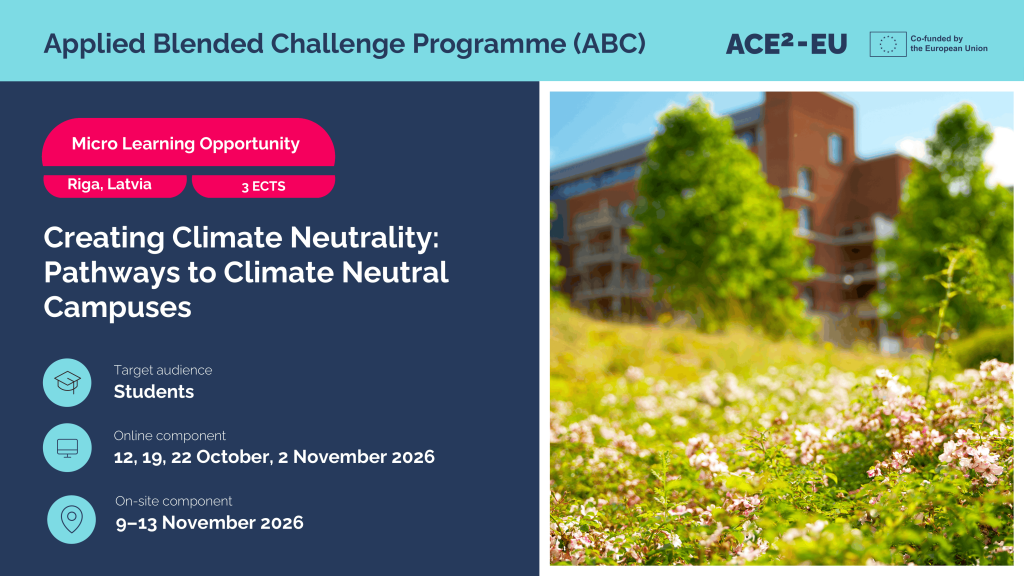
Course Type: Applied Blended Challenge (ABC) Programme
Duration: 8 hrs. synchronous online, 40 hrs on-site, 35 hrs independent and group work before and after the course
Dates: Online component — October 12, 19, 22, CET 16:00-18:00; November 2, CET 16:00-18:00 · On-site component — November 9 to November 13, 2026, Riga, Latvia
Credits: 3 ECTS credits and a certificate of attendance
The ABC programme “Pathways to Climate Neutral Campuses – Co-Creating Action Plans for Sustainable Universities” is a practice-oriented course in which students work in interdisciplinary teams to develop realistic climate action solutions for higher education institutions. Through online sessions and onsite workshops in Riga, participants explore climate neutrality, sustainability, and environmental governance in universities, focusing on key impact areas such as energy use, mobility, waste, infrastructure, and resource consumption.
Application deadline
00
Days
00
Hours
00
Minutes
00
Seconds
Applications are now closed.
Organized by: Latvian Academy of Culture (LAC), Latvia — Rūdolfs Kivlenieks, Asnāte Kalēja (coordinator); Lietuvos Inzinerijos Kolegija Higher Education Institution (LIK), Lithuania — Gitana Vyčienė, Vilda Grybauskienė
External stakeholders: ESG consulting agency “Sustinere Latvia”
The ABC programme “Pathways to Climate Neutral Campuses – Co-Creating Action Plans for Sustainable Universities” is a practice-oriented course in which students work in interdisciplinary teams to develop realistic climate action solutions for higher education institutions. Through online sessions and onsite workshops in Riga, participants explore climate neutrality, sustainability, and environmental governance in universities, focusing on key impact areas such as energy use, mobility, waste, infrastructure, and resource consumption. During the onsite mobility week, students identify sustainability challenges, assess environmental impacts, and develop Climate Neutrality Guidelines or Climate Action Plans for real university contexts. They apply practical tools such as stakeholder mapping, basic carbon footprint logic, resource-flow analysis, prioritisation methods, and design thinking to transform challenges into feasible solutions. The programme combines theoretical input with practical workshops and field visits enabling students to connect sustainability frameworks with real institutional implementation.
Online sessions (October 12 to November 2): Students’ baseline knowledge of climate neutrality concepts, sustainability governance, and institutional environmental performance is assessed through structured discussions and preparatory analytical tasks. This phase also equips them with methodological tools for campus-level analysis.
Onsite sessions (Riga, November 9–13, 2026): The onsite mobility week functions as an applied sustainability laboratory where students work intensively in interdisciplinary teams to develop practical climate action proposals for universities. Participants engage with real university sustainability challenges covering areas such as energy efficiency, mobility systems, waste and circular resource management, infrastructure performance, and sustainability governance. Workshops combine short expert inputs with hands-on application sessions focused on environmental impact assessment, stakeholder mapping, prioritisation of sustainability interventions, feasibility analysis, climate action planning, and creative design thinking. The programme also includes field visits to sustainability-related sites and initiatives in Riga. Each team develops a structured final output in the form of either Climate Neutrality Guidelines or a Climate Action Plan for a defined university context, including a clear problem definition, strategic objectives, proposed interventions, implementation timeline, responsible stakeholders, and monitoring indicators. The mobility week concludes with final presentations and reflection sessions.
Follow-up / reflection: In an online session held after the mobility week, interdisciplinary teams present the refined version of their Climate Neutrality Guidelines or Climate Action Plan and reflect on their learning process. Students critically assess how their initial knowledge and baseline analysis developed into practical solutions, what challenges they encountered in translating sustainability concepts into operational measures, and how interdisciplinary collaboration influenced decision-making. Where possible, presentations are shared with university management representatives.
- Explain the concept of climate neutrality and its relevance to environmental safety, sustainability, and institutional resilience in higher education.
- Identify and analyze key sources of greenhouse gas emissions and environmental impacts within a university context, including energy use, mobility, waste, and resource management.
- Collaborate effectively in interdisciplinary and international teams to co-create practical sustainability solutions.
This course may be suitable for students from ACE²-EU partner universities enrolled in undergraduate or postgraduate programs in the following fields: Environmental science, sustainability studies, and climate studies · Engineering and architecture · Project management, public policy, urban development · Education and social sciences.
This course may be suitable for those who have an interest in: Climate neutrality, sustainability, and environmental responsibility · Public policy, sustainable governance · Engineering and architecture.
Recommended Language Level: An intermediate level of English (B2), as the working language will be English.
Apply here: https://forms.gle/AdD1M8HgEZQc79RCA
Deadline for receipt of applications: 25 July 2026
Please note that submitting an application does not guarantee a place on the programme. Participating institutions apply their own internal selection procedures. Prior to the start of the course, selected participants will receive a welcome email from the ACE²-EU Alliance containing detailed information and instructions specific to the programme.