
ligia.monterroso@essaude.ipsantarem.pt

Ethics in Interprofessional Work
23 November 2026
-
27 November 2026
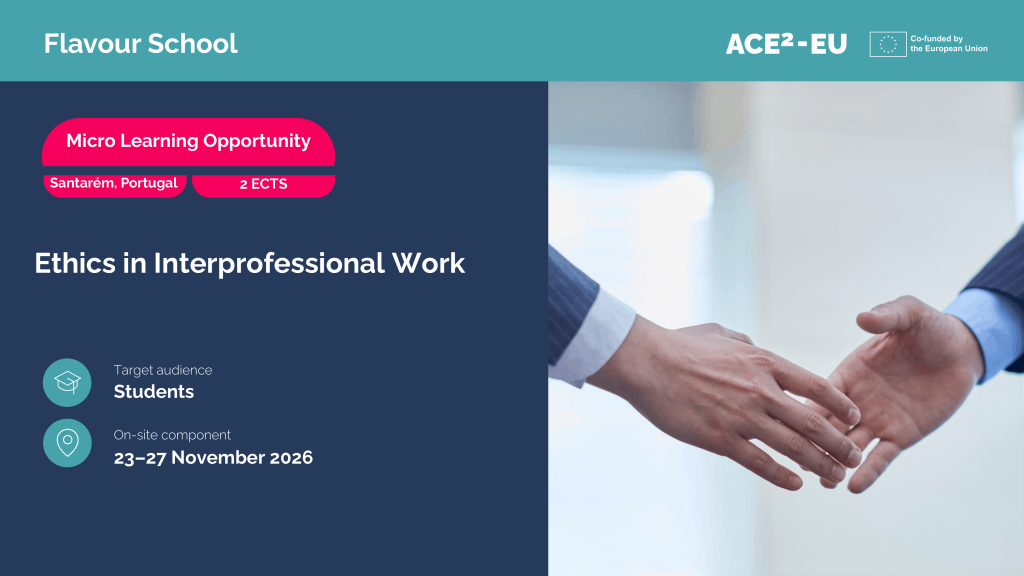
Course Type: Flavour School
Duration: 25 hrs Seminar; Workshop; mentoring; theoretical practice + x hrs autonomous work
Dates: Presential component — 23–27 November 2026 (Monday to Friday)
Credits: 2 ECTS credits and a certificate of attendance
Flavour Schools are short, immersive five-day summer or winter schools developed within the ACE²-EU Alliance under the WP2 – APP Factory. In this context, the school of Interprofessional Work Ethics will invite students to explore, through teamwork and applied practice, how professionals from different fields can respond to ethical dilemmas in the workplace with empathy, equality, fairness and justice, promoting a deeper understanding of work contexts.
Application deadline
00
Days
00
Hours
00
Minutes
00
Seconds
Applications are now closed.
Organised by: Instituto Politécnico de Santarém (Portugal) — Maria José Nogueira, Lígia Eduarda Pereira Monterroso, Helena Caseiro, Sandra Costa
Partner: Goce Delcev University (Macedonia) — Daniela Baklioska
External stakeholders: Santarém City Council, IEFP – Public employment center that supports job searching, Lezíria Local Health Unit
This course is essential for training professionals capable of understanding the foundations of ethics, analyzing complex dilemmas, and making fair decisions. Furthermore, it develops critical skills to deal responsibly with the challenges posed by technological innovations and scientific research.
On-site sessions: During the face-to-face week, participants engage in an integrated learning experience that combines theoretical knowledge, problem-based learning (PBL) and cooperative group work. The programme progresses from understanding the principles and scope of ethics to exploring its practical and communicative dimensions. The first sessions introduce the philosophy of ethical principles and the need to respond coherently and calmly to everyday problems. As the week progresses, participants work together on cases that address simulated practice issues, where decision-making is central to the smooth functioning of teams. The course ends with activities focused on teamwork and interdisciplinarity, where participants reflect on their learning outcomes and share ideas through collective discussions and a moment of cultural exchange.
Follow-up / reflection: During this week, group activities will be proposed so that students can interact with each other, discuss topics, and present to the other participants in class. Course evaluation will be based on attendance at the proposed activities and completion of a satisfaction questionnaire.
- Acquire informational knowledge and specific ethical standards.
- Develop skills for analyzing and resolving ethical dilemmas.
- Understand the principles and ethical practices of scientific research.
- Analyze the ethical implications of emerging technologies and innovations in the professional domain.
- Develop critical and ethical thinking skills to address complex situations and make informed and fair decisions.
By the end of the course, students will be able to:
- Apply informational knowledge and specific ethical standards in professional practice.
- Identify, analyse, and resolve ethical dilemmas in a critical and responsible manner.
- Understand and adopt principles and ethical practices in scientific research.
- Assess the ethical implications of emerging technologies and innovations in the professional domain.
- Develop critical and ethical thinking to make fair and well-founded decisions in complex situations.
This course may be suitable for students from ACE²-EU partner universities and university, any area.
This course may be suitable for those who have an interest in: solving problems, building a more fair and equitable team and work spirit.
Recommended Language Level: Basic to intermediate level of English (B1-B2), as the working language will be English.
Apply here: https://forms.gle/hYCuv3Qb9xHjTo7GA
Deadline for receipt of applications: 14 October, 2026
A notification of acceptance to participate will be sent to successful applicants on the day 28 of month October 2026 (an acceptance letter will be sent by the host institution and will include program registration details).