

Circular Economy and Long-term Impact
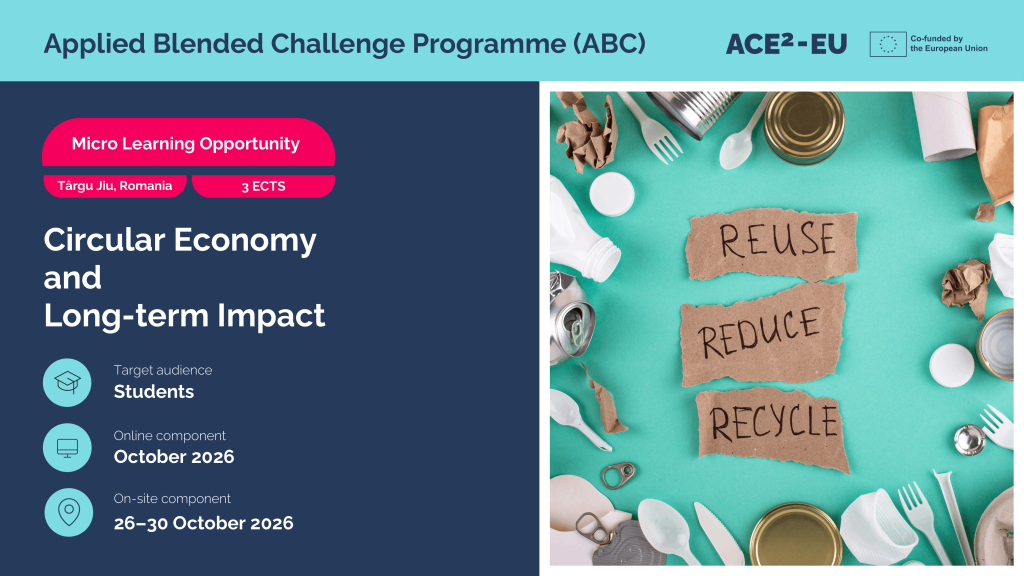
Course Type: Applied Blended Challenge (ABC) Programme
Dates: Online component — October 2026 · On-site component — 26–30 October 2026, Romania
Credits: 3 ECTS credits and a certificate of attendance
This course aims to help students understand how the current linear economic model contributes to environmental challenges and how it can be transformed into a more sustainable, circular system. Students will learn the key principles of the circular economy, including reducing waste, keeping materials in use, and designing products for longevity.
Application deadline
Applications are now closed.
Organised by: Constantin Brâncuși University, Romania — Rodica David, dr. Cătălin Șchiopu
Lietuvos Inzinerijos Kolegija (LIK) — Assoc. prof. dr. Raimondas Šadzevičius
Universidad Francisco de Vitoria (UFV) — Vicente Ruiz Aguarón
External stakeholders: MACOFIL SA, CRILELMAR SRL, CEO
This course aims to help students understand how the current linear economic model contributes to environmental challenges and how it can be transformed into a more sustainable, circular system. Students will learn the key principles of the circular economy, including reducing waste, keeping materials in use, and designing products for longevity.
Throughout the course, students will develop a systems perspective, allowing them to analyse how resources flow through production and consumption processes. They will explore how products and services can be redesigned to minimise environmental impact and how businesses can adopt circular models that are both sustainable and economically viable.
The course also introduces tools for evaluating environmental performance, as well as the role of policies in supporting circular practices. In addition, students will reflect on the social and behavioural aspects of sustainability.
Online sessions (October 2026, synchronous & independent learning activities): Introduction to circular economy concepts, sustainable resource management, and long-term environmental impact. Interactive lectures on mine waste valorisation, industrial symbiosis, resource recovery technologies, and sustainable practices. Guest speaker sessions exploring innovation, green entrepreneurship, and sustainable solutions. Collaborative discussions on current environmental challenges and opportunities for circular transition. Group formation and project preparation for the on-site component. Independent research activities focused on identifying local sustainability challenges and examples of circular economy practices. Reflection exercises encouraging participants to connect theoretical concepts with real-world applications and their local contexts.
Onsite sessions (26–30 October 2026, Romania, 40h): Participants will work in interdisciplinary and international teams to explore the topic “Circular Economy and Long-term Impact”, addressing challenges related to sustainable resource management, waste valorisation, industrial symbiosis, green entrepreneurship, and the transition towards more sustainable communities. Interactive workshops and expert-led sessions on circular economy principles, sustainable mining, resource recovery technologies, and green innovation. Stakeholder visits to local industries and enterprises. Guest lectures and dialogues with industry professionals, entrepreneurs, and sustainability experts. Mentored group work focused on analysing real cases and developing innovative circular economy solutions. Reflection circles and feedback sessions. Intercultural and networking activities. Final project presentations and exhibition.
Follow-up & reflection: Reflection and feedback session on the learning experience and stakeholder visits. Finalisation and presentation of group project outcomes and sustainability solutions. Individual reflection on circular economy, sustainable development, and green entrepreneurship. Evaluation of the long-term impact of proposed solutions and their applicability in local contexts. Assessment of acquired knowledge, skills, and intercultural learning outcomes.
- Understand the principles and applications of circular economy in addressing environmental and societal challenges.
- Explore sustainable resource management, waste valorisation, industrial symbiosis, and green innovation practices.
- Develop practical knowledge of sustainable mining, resource recovery technologies, and their contribution to long-term impact.
- Strengthen problem-solving, critical thinking, and systems-thinking skills through challenge-based learning.
- Connect academic knowledge with real-world sustainability challenges through stakeholder engagement and industry visits.
- Foster interdisciplinary collaboration, intercultural communication, and teamwork in an international learning environment.
- Promote awareness of sustainable entrepreneurship and innovation as drivers of circular transition.
- Encourage reflection on the social, economic, and environmental dimensions of sustainability and their relevance to local and global contexts.
Level: Undergraduate and postgraduate students from ACE²-EU partner universities.
Fields: Environmental Engineering · Engineering and Technology · Environmental Sciences · Sustainability Studies · Natural Sciences · Business and Management · Economics · Geography and Regional Development · all related fields.
Language: English B1–B2.
Apply here: https://forms.gle/mG2HrjGhJzk2BCAy7
Deadline for receipt of applications: 20 July 2026
Please note that submitting an application does not guarantee a place on the programme. Participating institutions apply their own internal selection procedures. Prior to the start of the course, selected participants will receive a welcome email from the ACE²-EU Alliance containing detailed information and instructions specific to the programme.