

Functional Food: When Science Meets Bioeconomy and Creates Health Lifestyle
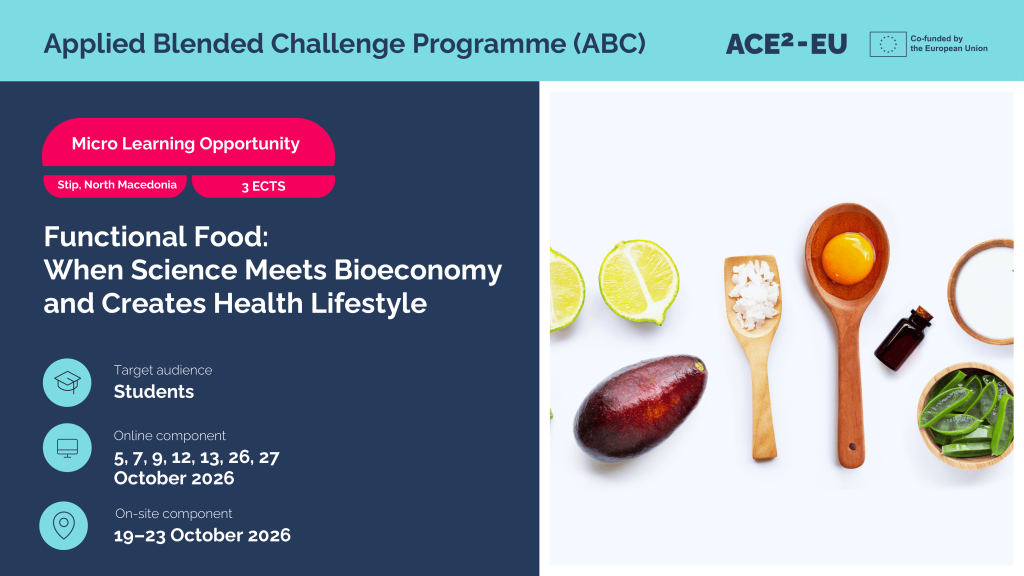
Course Type: Applied Blended Challenge (ABC) Programme
Dates: Online component — 5, 7, 9, 12, 13, 26, 27 October 2026, 10:00–12:00 CEST · On-site component — 19–23 October 2026
Credits: 3 ECTS credits and a certificate of attendance
The agri-food sector is rapidly moving toward bioeconomy and functional ingredients — extracting maximum value from grapes, olives, sunflower, flaxseed and berry by-products to create healthier, more sustainable food and beverages. This ABC tackles a real-world challenge: How can researchers, food technologists and producers transform wines and edible oils into high-value functional products while ensuring stability, safety and proven bioactivity?
Application deadline
Applications are now closed.
Goce Delčev University — Teachers: Sanja Kostadinović Veličkovska (Lead), Emilija Miteva Kacarski
Universidad Francisco de Vitoria, Spain — Teacher: Estela Pérez Lago
Polytechnic University of Santarém — Teachers: Ana Teresa C. Machado Ribeiro, Helena Maria C. Sousa Mira
External stakeholders: Local Macedonian wineries (host on-site visits, real-world context for wine chemistry and functional-wine development); Cold-pressed edible-oil producers (practical context for edible-oil chemistry, cold-pressing techniques and functional-oil formulation)
The agri-food sector is rapidly moving toward bioeconomy and functional ingredients — extracting maximum value from grapes, olives, sunflower, flaxseed and berry by-products to create healthier, more sustainable food and beverages. This ABC tackles a real-world challenge: How can researchers, food technologists and producers transform wines and edible oils into high-value functional products while ensuring stability, safety and proven bioactivity?
Working alongside Macedonian wineries and oil producers, students apply principles of wine chemistry, edible-oil chemistry, controlled fermentation and cold-pressing. They learn to design functional wines with low alcohol and high bioactive content and functional edible oils from germinated seeds, and to identify, quantify and characterise key bioactive compounds — anthocyanins, proanthocyanins, flavonoids, tannins, resveratrol, phytosterols, Vitamin-E compounds, carotenoids and fatty acids.
Online sessions (5–27 October 2026 · 20h synchronous, 10:00–12:00 CEST): Functional fermented beverages — vinification, wine-making and fermentation with selected wine yeasts. Chemical composition of wines and grape pomace. Curated readings and recorded lectures. Knowledge quizzes and participation in online debates to promote critical analysis and exchange. Online dates: 5, 7, 9, 12, 13, 26 and 27 October 2026.
On-site sessions (19–23 October 2026 · 25h · UGD): Practical laboratory work at UNILAB (Faculty of Agriculture) on wine chemistry, wine control, edible-oil quality and food control. Winery visit in Macedonia — connecting academic learning to real industry practices. Hands-on analytical sessions: identification and quantification of bioactive compounds using current analytical techniques. Workshops and scientific meetings. Discussion of joint research opportunities and publishing in international journals.
Independent / group work (45 hours): Critical analysis of scientific literature on bioactive compounds. Group design work on functional-food formulations. Reflection on environmental and economic implications of by-product valorisation.
- Provide students with solid knowledge of wine markets, supply chains, international laws and cultural considerations relevant to the wine industry.
- Provide students with knowledge of vinification and wine-making, controlled fermentation and production of functional wines with low alcohol and high bioactive content.
- Provide students with solid knowledge of cold-pressing, germination of oil seeds and production of functional edible oils with high bioactive content.
- Understand the phytochemical composition of raspberry, blackberry and grape pomace, with emphasis on identification, quantification and characterisation of anthocyanins, proanthocyanins, flavonoids, tannins and resveratrol.
- Understand the phytochemical composition of raspberry and blackberry cake after cold-pressing (pomace), with emphasis on free fatty acids, fatty acids, Vitamin-E-active compounds, carotenoids and phytosterols.
Level: Undergraduate and postgraduate students from ACE²-EU partner universities.
Fields: Agriculture · Biotechnology · Nutrition · Food Science.
Mindset: Motivated to work in multidisciplinary international teams developing functional-food solutions with positive health impact.
Language: English B1–B2.
Apply here: https://forms.gle/EPgQPLo9W497pWKU7
Deadline for receipt of applications: 20 July 2026
Please note that submitting an application does not guarantee a place on the programme. Participating institutions apply their own internal selection procedures. Prior to the start of the course, selected participants will receive a welcome email from the ACE²-EU Alliance containing detailed information and instructions specific to the programme.