
Elizabete Palasiosa — elizabete.palasiosa@lka.edu.lv

This event has passed.
Urban Future Public Space Lab: Art, Design & Technology for People
31 August 2026
-
4 September 2026
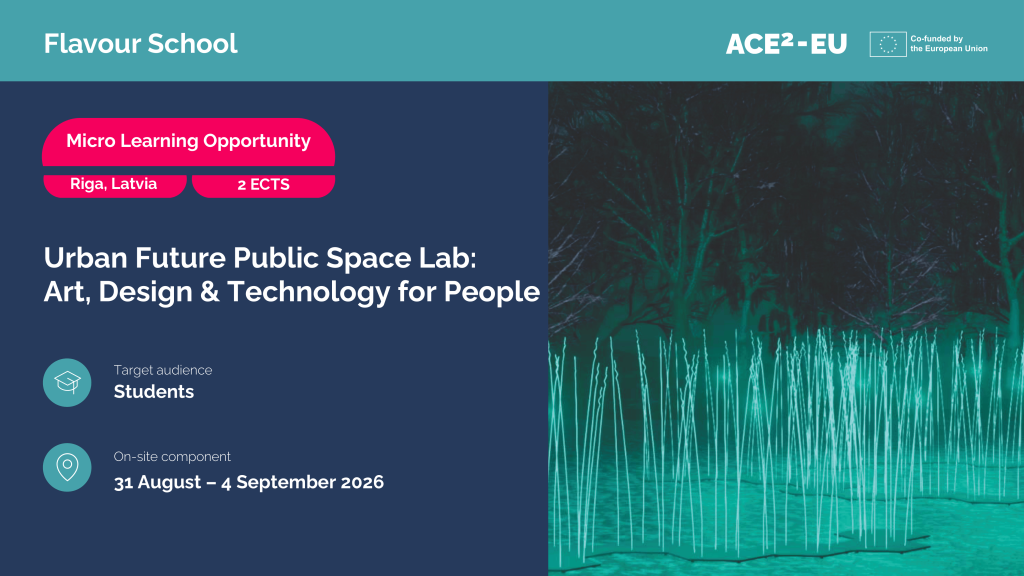
Course Type: Flavour School
Duration: 25 hours (on-site) · On-site mobility week — 31 August – 4 September 2026
Location: Riga, Latvia
Credits: 2 ECTS credits and a certificate of attendance
Join the ACE²-EU Flavour School and create light-based art experiences for the Riga Light Festival. In international, interdisciplinary teams, you’ll explore the city, develop concepts, and turn ideas into real, public-space installations. Learn hands-on skills in design, technology, sustainability, and collaboration, while producing a complete project plan that could be realised in the festival.
Application deadline
00
Days
00
Hours
00
Minutes
00
Seconds
Applications are now closed.
Lead and Host Institution: Latvian Academy of Culture (Latvia) — Elizabete Palasiosa
Partner Institutions: Universidad Francisco de Vitoria (Spain) — María Gutiérrez Pérez, Claudia Peinado Cruz; Carinthia University of Applied Sciences (Austria) — Andrea Stitzel, Georg Riesenhuber; Technische Hochschule Ingolstadt (Germany) — Stefanie Wrobel; Medical University of Gdańsk (Poland) — Aniela Brzezińska
External Stakeholders: Riga Light Festival, Riga City Municipality
The ACE²-EU Flavour School is an intensive, practice-based programme held in Riga, where students from diverse disciplines collaborate in international teams to design festival-ready light-art concepts for public space.
Participants will learn how to move from early exploration and idea generation to a clear and feasible project plan by integrating: artistic narrative and storytelling · site-specific spatial design · technical planning (lighting sources, power supply, control systems) · safety and sustainability considerations.
The course responds to the growing demand for professionals capable of designing meaningful, environmentally responsible interventions in real urban contexts — skills increasingly relevant across the creative industries, technology, and public-sector innovation.
Online: Pre-briefing online session (date to be confirmed after registration).
On-site (5-day structured process, with continuous mentor support):
Day 1 — Urban Exploration & Sensory Mapping: Introduction to the Riga Light Festival and light as a spatial and social medium. Guided site visits, location scouting, documentation, and group reflection.
Day 2 — Team Formation & Thematic Focus: Balanced team formation, expert inputs, ideation sessions, and initial concept framing.
Day 3 — Concept Definition & Spatial Strategy: Development of a site-specific concept, narrative, and interaction strategy. Site revisits for measurements and constraints. Mid-review critique.
Day 4 — Prototyping & Technical Development: Prototype testing and technical planning (lighting, power, control systems, materials, assembly). Safety and sustainability checks.
Day 5 — Final Project Definition & Presentation: Finalisation of drawings, technical specifications, activation plans, and production timelines. Presentation and reflective discussion.
Follow-up: Each team finalises and submits a feasible project package (concept description, site documentation, drawings/prototype evidence, technical solution, implementation/dismantling plan). Selected projects may be produced and installed as part of the Riga Light Festival, with teams invited to follow through practical set-up.
By the end of the course, students will be able to:
- Conduct a site analysis for a light-based public-space intervention.
- Develop a site-specific concept and narrative defining the intended audience experience and the role of light.
- Translate a creative idea into a feasible project plan with technical requirements for light sources, power, and control.
- Create and test a prototype to validate key elements of the concept.
- Apply safety and sustainability criteria, selecting low-impact or reusable materials.
- Produce a complete “feasible project package.”
- Communicate and defend the project through a final presentation.
- Collaborate effectively in an interdisciplinary, international team.
Suitable for undergraduate and postgraduate students from ACE²-EU partner universities in areas such as: Art, Design, Architecture, Spatial and Landscape Design · Media Arts, IT/Creative Technologies, Interaction Design · Performing Arts, Sound Design, Dramaturgy · Urban and Environmental Studies.
Particularly relevant for students interested in: site-specific light art and public-space interventions · interdisciplinary teamwork and prototyping · developing festival-ready, real-world projects.
Recommended Language Level: English B1–B2.
Apply here: https://forms.gle/TPcyPaCeBerDcSVh6
Application deadline: 10 May 2026
Notification of acceptance: 17 May 2026 (acceptance letters issued by the host institution)