- This event has passed.
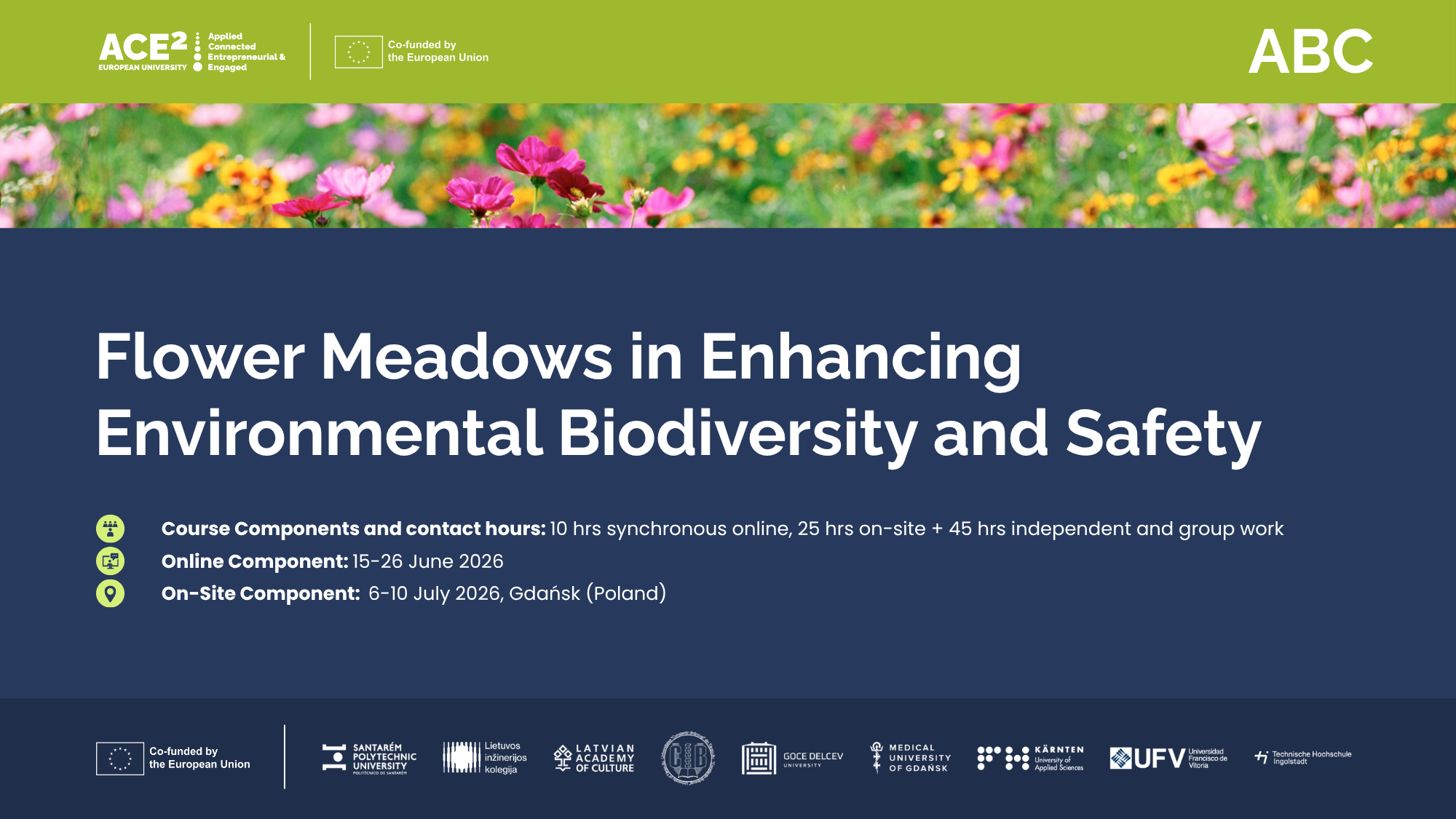
Flower Meadows in Enhancing Environmental Biodiversity and Safety
Course Type: Applied Blended Challenge (ABC) Programme
Duration and Timeline:
- Course components and contact hours: 10 hrs synchronous online, 25 hrs on-site + 45 hrs independent and group work
- Online component: 15–26 June 2026 (Warsaw: Central European Time (CET) UTC+2h)
- On-site component: 06–10 July 2026, it will take place: Gdańsk (Poland)
- Follow-up / reflection: 16 of July 2026 (online)
Award, Credits and Certification
On successful completion of the course participants will receive 3 ECTS credits and a certificate of attendance
Organised by:
Medical University of Gdańsk (Poland) Lead and Host Institution
Anna Hering, PhD, ASSISTANT PROFESSOR
Lecturers: Justyna Stefanowicz-Hajduk, Pharm.D. MUG, ASSISTANT PROFESSOR, Aniela Brzezińska, MSc, Psychologist, Doctoral Researcher
LIK (Lithuania)
Sandra Saunoriūtė, PhD, ASSISTANT PROFESSOR
Carinthia University of Applied Sciences (Austria)
Rudolf Markt, PhD, ASSISTANT PROFESSOR
External stakeholders that will be involved in the course:
Primary school nr 3 in Gdańsk (Poland)
Primary school nr 5 in Bytów (Poland)
Gestor – management and administration of real estate – housing communities in Gdańsk (Poland)
Which students would find this course useful?
This course may be suitable for students from ACE2-EU partner universities enrolled in undergraduate and postgraduate programmes in the following fields:
-
- Environmental and public health,
- Food science and engineering,
- Dietetics and sports,
- Environmental sciences,
- Chemical sciences, biotechnology, pharmacy, medicine
This course may be suitable for those who have an interest in:
-
- urban plants and their safety,
- healthy environment and well-being.
- Recommended Language Level:
- Intermediate level of English (B1), as the working language will be English
Application Process:
Interested applicants should
🔗 Apply here: https://forms.gle/xCYvysNpaaXy6Qoq8
Deadline for receipt of applications: 15 May 2026
Course Description and Learning Objectives
This course explores the role of flower meadows in urban environments and how they shape our well-being, mental health, and the surrounding ecosystem. You will discover how flowers contribute to human health and environmental sustainability, and learn about sustainable cultivation practices, plant types and composition, and how changes in plant populations affect the soil. By connecting botany, microbiology, and urban planning, the course shows why bringing more flowers into our cities matters — for people, for nature, and for the health of the whole ecosystem.
Course Description:
- Online sessions: Online lectures introduce the key concepts of the course: plant diversity and climate change, and how the soil ecosystem changes when native plants are replaced. Sessions include group discussions and preparatory readings. Dates: 15– 26 June 2026.
- On-site sessions: A five-day intensive programme combining workshops, field activities, and laboratory experiments. You will work directly with local stakeholders to explore real-world challenges and develop practical solutions. Dates: 06–10 July 2026 in Gdańsk (Poland).
- 🌿 Psychology of Nature session (led by Aniela Brzezińska, MUG): a lecture on how flower meadows and green urban spaces affect psychological well-being, covering concepts such as eco-anxiety, restorative environments, and the mental health benefits of biodiversity. The session is followed by a guided mindfulness walk in a local park, giving students a structured, experiential practice for connecting with nature intentionally.
- Follow-up / reflection: Online group presentations of lab reports and advertising campaigns, followed by a shared reflection space to discuss insights and takeaways from the course. Date: 16 July 2026 (online)
Specific learning objectives include:
- Understand the impact of climate change on the environment and oxidative stress
- Learn about sustainable urban planning practices and biodiversity
- Learn how to relax the body and mind in nature
- Become familiar with plants and how they can influence our well-being
- Explore the impact of plants on human cells (in vitro research)
By the end of the course, students will be able to:
- Remember & understand – the principles of introducing flower meadows into urban areas to support biodiversity, and their impact on the environment, on human health, and on oxidative stress in the body.
- Teaching methods: Lectures, guest talks.
- Assessment: Short quizzes, reflection notes.
- Apply – demonstrate how being surrounded by nature affects mood, attention span, and mental abilities, and learn how to relax in natural settings.
- Teaching methods: Case studies, field visits, practical demonstrations.
- Assessment: Field reports, group exercises.
- Analyse – investigate the links between plants, insects, soil microorganisms, and human health outcomes.
- Teaching methods: Data analysis workshops, literature reviews, group discussions. Lab classes (in-vitro research)
- Assessment: Analytical essays, lab reports.
- Evaluate – critically assess urban design and the role of nature in promoting health and sustainability, including how to address the lack of space for greenery in cities.
- Teaching methods: Debates, critical reading sessions.
- Assessment: Group presentations.
- Create – propose evidence-based strategies to introduce greenery into urban spaces and strengthen biodiversity, helping to reduce oxidative stress and, as part of the work, design advertising campaigns to promote these ideas.
- Teaching methods: Design thinking and practical workshops, lab classes.
- Assessment: Group presentations.
Further Information
For any further information or queries related to the course, please contact:
E-mail: ace2eu@ufv.es