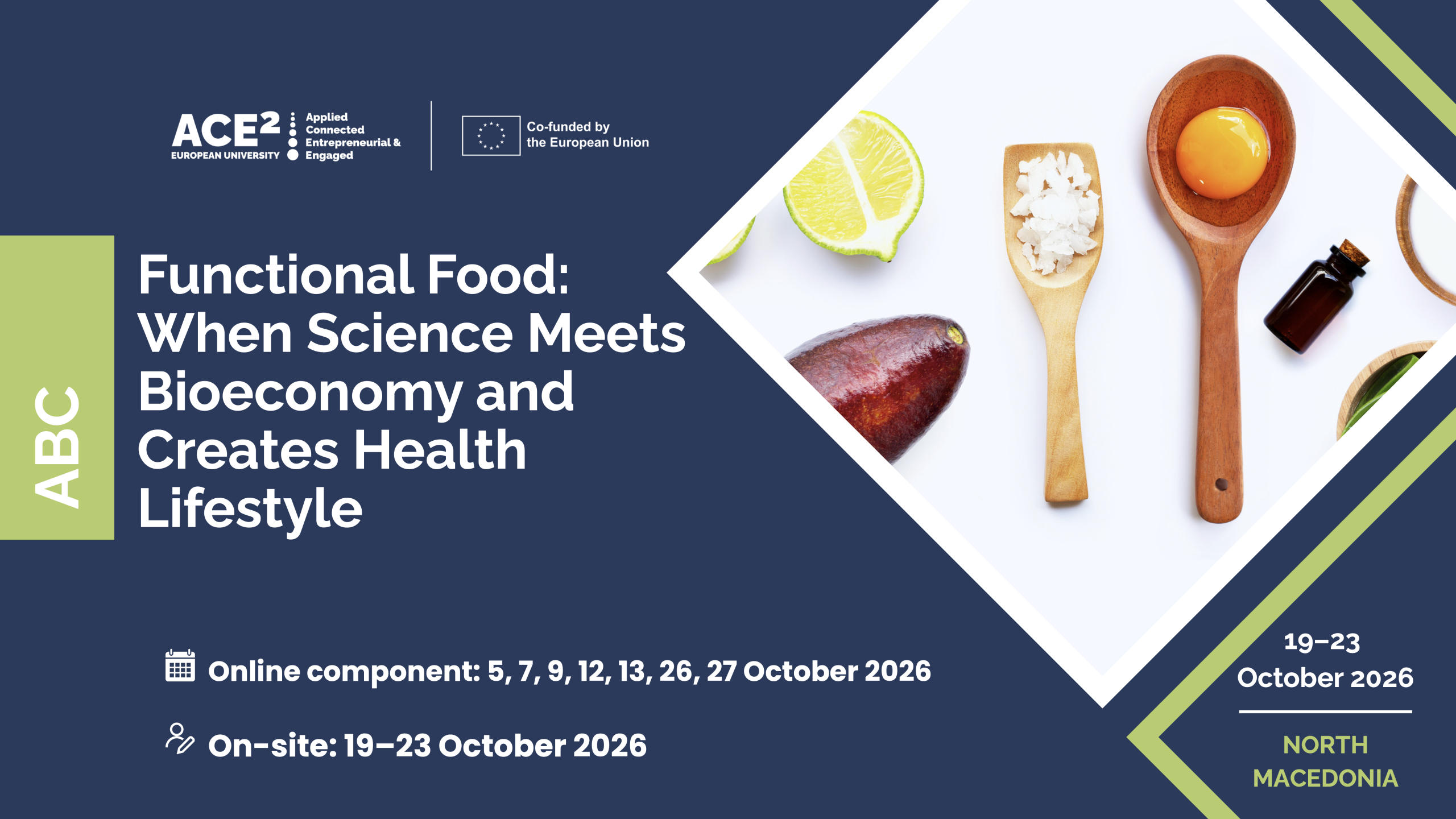
Functional Food: When Science Meets Bioeconomy and Creates Health Lifestyle
Course Type: Applied Blended Challenge (ABC) Program
Duration and Timeline:
Online component: 5, 7, 9, 12, 13, 26, 27 October 2026 · 10:00–12:00 CEST
On-site component: 19–23 October 2026
Award, Credits and Certification
On successful completion of the course, participants will receive 3 ECTS credits and a certificate of attendance
Organized by:
Goce Delčev University
Teachers : Sanja Kostadinović Veličkovska (Lead), Emilija Miteva Kacarski
Universidad Francisco de Vitoria, Spain
Teacher : Estela Pérez Lago
Polytechnic University of Santarém
Teachers : Ana Teresa C. Machado Ribeiro, Helena Maria C. Sousa Mira
External stakeholders that will be involved in the course:
| Stakeholder | Sector / Role |
| Local Macedonian wineries | Host on-site visits · Real-world context for wine chemistry and functional-wine development |
| Cold-pressed edible-oil producers | Practical context for edible-oil chemistry, cold-pressing techniques and functional-oil formulation |
Course Description and Learning Objectives
The agri-food sector is rapidly moving toward bioeconomy and functional ingredients — extracting maximum value from grapes, olives, sunflower, flaxseed and berry by-products to create healthier, more sustainable food and beverages. This ABC tackles a real-world challenge: How can researchers, food technologists and producers transform wines and edible oils into high-value functional products while ensuring stability, safety and proven bioactivity?
Working alongside Macedonian wineries and oil producers, students apply principles of wine chemistry, edible-oil chemistry, controlled fermentation and cold-pressing. They learn to design functional wines with low alcohol and high bioactive contentand functional edible oils from germinated seeds, and to identify, quantify and characterise key bioactive compounds -anthocyanins, proanthocyanins, flavonoids, tannins, resveratrol, phytosterols, Vitamin-E compounds, carotenoids and fatty acids.
Course Description:
Online sessions: 5–27 October 2026 · 20h synchronous (10:00–12:00 CEST)
Synchronous and asynchronous activities focused on:
- Functional fermented beverages — vinification, wine-making and fermentation with selected wine yeasts
- Chemical composition of wines and grape pomace
- Curated readings and recorded lectures
- Knowledge quizzes and participation in online debates to promote critical analysis and exchange
Online dates: 5, 7, 9, 12, 13, 26 and 27 October 2026
Onsite sessions: 19–23 October 2026 · 25h · UGD
Immersive experience including:
- Practical laboratory work at UNILAB (Faculty of Agriculture) on wine chemistry, wine control, edible-oil quality and food control
- Winery visit in Macedonia — connecting academic learning to real industry practices
- Hands-on analytical sessions: identification and quantification of bioactive compounds using current analytical techniques
- Workshops and scientific meetings
- Discussion of joint research opportunities and publishing in international journals
Independent / group work — 45 hours
- Critical analysis of scientific literature on bioactive compounds
- Group design work on functional-food formulations
- Reflection on environmental and economic implications of by-product valorisation
Specific learning objectives include:
- Provide students with solid knowledge of wine markets, supply chains, international laws and cultural considerations relevant to the wine industry
- Provide students with knowledge of vinification and wine-making, controlled fermentation and production of functional wines with low alcohol and high bioactive content
- Provide students with solid knowledge of cold-pressing, germination of oil seeds and production of functional edible oils with high bioactive content
- Understand the phytochemical composition of raspberry, blackberry and grape pomace, with emphasis on identification, quantification and characterisation of anthocyanins, proanthocyanins, flavonoids, tannins and resveratrol
- Understand the phytochemical composition of raspberry and blackberry cake after cold-pressing (pomace), with emphasis on free fatty acids, fatty acids, Vitamin-E-active compounds, carotenoids and phytosterols
Which students would find this course useful for them?
👥 Who Should Apply?
🎓 Level: Undergraduate and postgraduate students from ACE²-EU partner universities
🌍 Fields: Agriculture · Biotechnology · Nutrition · Food Science
🤝 Mindset: Motivated to work in multidisciplinary international teams developing functional-food solutions with positive health impact
🗣️ Language: English B1–B2
Application Process:
Interested applicants should
🔗 Apply here: https://forms.gle/EPgQPLo9W497pWKU7
Deadline for receipt of applications: 20 July 2026
Please note that submitting an application does not guarantee a place on the programme. Participating institutions apply their own internal selection procedures.
Prior to the start of the course, selected participants will receive a welcome email from the ACE²-EU Alliance containing detailed information and instructions specific to the programme.
Further Information
For any further information or queries related to the course, please contact: