
João Cabral — joao.cabral@ese.ipsantarem.pt

Between Grain and Pixel – Analogue and Digital Documentary Photography:
9 November 2026
-
13 November 2026
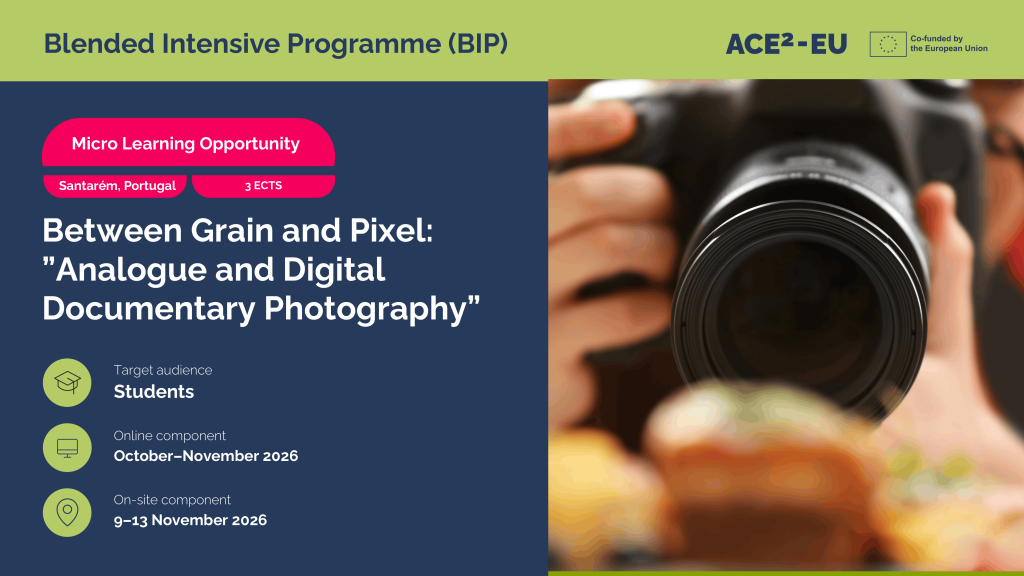
Course Type: Blended Intensive Programme (BIP)
Duration: Synchronous online — 17h · On-site (physical mobility) — 35h · Independent and group work — 30h
Dates: Online component — October–November 2026 · On-site component — 9–13 November 2026, Santarém, Portugal
Credits: ECTS credits — awarded upon at least 80% attendance and satisfactory achievement of the learning objectives
This course explores how we tell real stories through photography, using both analogue (film) and digital techniques. The main challenge is to understand how different tools and processes influence the way we see, record and interpret the world around us. The course is designed for students from different audiovisual disciplines and countries.
Application deadline
00
Days
00
Hours
00
Minutes
00
Seconds
Applications are now closed.
Lead and Host Institution: Instituto Politécnico de Santarém (Portugal) — João Cabral, Teresa Cavalheiro, Ana Loureiro
Partner Institutions: Universidad Francisco de Vitoria (Spain) — Manuel Casal; National Film School of the Latvian Academy of Culture — Daiga Livcane, Andrejs Verhoustinskis
External stakeholders: Pantalha – Soluções de Áudio e Vídeo; VienaDiena.lv and photographer Ilmars Znotins
This course explores how we tell real stories through photography, using both analogue (film) and digital techniques. In real life, documentary photography is present in fields such as journalism, social media, activism and cultural projects — knowing how to use images consciously helps us communicate better, question what we see and give voice to different perspectives.
This subject is relevant because photography is not just a technique — it is also a way of thinking critically. Academically, it helps develop visual analysis and creativity. Professionally, it opens doors in fields such as communication, media and the arts. Socially, it allows us to better understand other realities and tell stories with impact and responsibility.
Online preparatory phase (October–November 2026) — Students are introduced to the core concepts of the course, including the natural heritage of the River Tagus. Inspirational sessions, case studies, guided discussions and preparatory information sessions support the development of ideas and the formation of teams, alongside individual/group research.
In-person mobility week (9–13 November, Santarém) — Focus on practical, hands-on learning. Students work in interdisciplinary and international teams in creative workshops, developing photographic images and artistic proposals under the guidance of the teaching staff and external stakeholders (Pantalha and VienaDiena.lv). Includes mentoring sessions, visits to cultural and heritage institutions, and collaborative work culminating in a photographic exhibition of the students’ work.
Learning Objectives:
- Develop the ability to observe the world critically and attentively, using photography as a tool for understanding reality.
- Explore the differences and connections between analogue and digital photography.
- Learn to tell clear and meaningful visual stories based on real-life situations and everyday contexts.
- Encourage creativity and experimentation.
- Promote the responsible use of images, reflecting on ethics, representation and social impact.
- Strengthen visual communication skills useful in different academic and professional fields.
- Encourage collaboration between participants from different cultures.
Learning Outcomes:
- Acquire cultural and visual literacy relating to the heritage of the River Tagus.
- Apply creative methodologies to real-world cultural challenges.
- Develop social skills: collaboration, adaptability and self-awareness.
- Develop artistic photo portfolio proposals based on heritage and sustainability.
- Collaborate effectively in international and interdisciplinary teams.
- Present their proposals professionally to stakeholders.
- Develop a personal style and narrative through creative experimentation in photography.
- Master the photographic process from image capture to final printing/enlargement.
Open to undergraduate and postgraduate students from ACE²-EU partner universities, particularly those studying or interested in: Design, Visual Arts, Multimedia · Architecture, Audiovisual Communication, Photography, Cinema.
Recommended Language Level: English B1–B2 (mandatory, as English is the working language of ACE²-EU courses).
Deadline for receipt of applications: 20 July 2026
Please note that submitting an application does not guarantee a place on the programme. Participating institutions apply their own internal selection procedures. Selected participants will receive a welcome email from the ACE²-EU Alliance with detailed information and instructions specific to the programme.