
judita.streimikiene@lik.tech

This event has passed.
Development of Engineering Skills: Racing for the Future
5 October 2026
-
9 October 2026
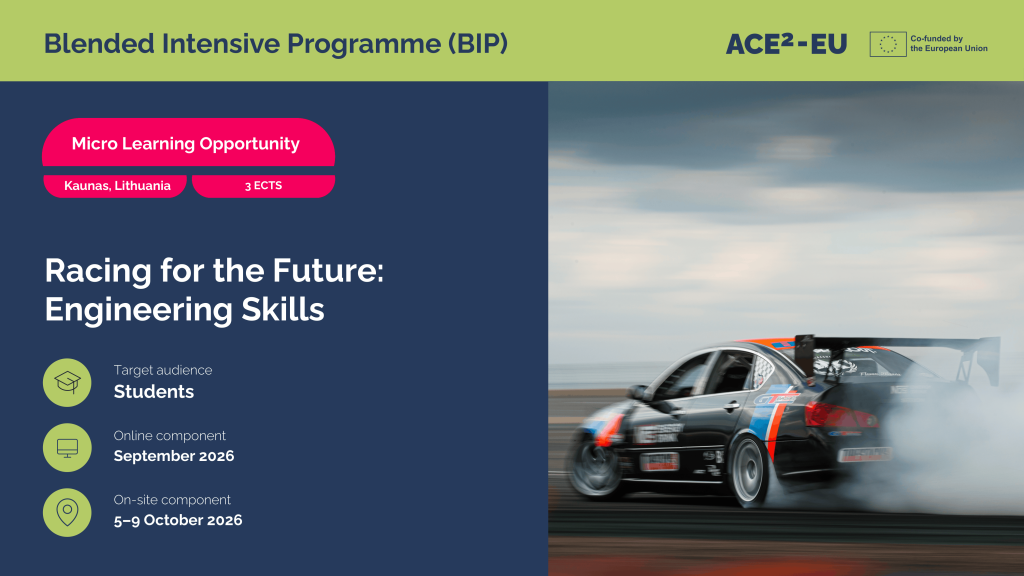
Course Type: BIP
Duration: 10 hrs. synchronous online, 20 hrs. on practical work/group work
Registration deadline: 30 June 2026
Dates: Online component — September 2026 · On-site component — 05–09 October 2026, Tvirtovės al. 35, Kaunas, Lithuania
Credits: 3 ECTS credits and a certificate of attendance
This course explores the development of core engineering skills through the interdisciplinary context of racing car design, construction, and performance optimisation. Using motorsport engineering as a real-world application, students engage with fundamental and advanced concepts in mechanical engineering, systems design, materials science, aerodynamics, data analysis, and project management.
Application deadline
00
Days
00
Hours
00
Minutes
00
Seconds
Applications are now closed.
Host and lead: Lietuvos Inzinerijos Kolegija (Lithuania)
Partner: Universidad Francisco de Vitoria (Spain)
Partner: Technische Hochschule Ingolstadt (Germany)
Tomas Liutkus, Povilas Bonkevičius, Marius Mažeika, Judita Štreimikienė, Víctor Ossorio Moles, Tobias Albrecht
External stakeholders: Representatives of different companies involved in sports car activities, FIA members
This course explores the development of core engineering skills through the interdisciplinary context of racing car design, construction, and performance optimisation. Using motorsport engineering as a real-world application, students engage with fundamental and advanced concepts in mechanical engineering, systems design, materials science, aerodynamics, data analysis, and project management. The course emphasises problem-solving, innovation, and teamwork while integrating theoretical knowledge with practical, hands-on activities. By examining contemporary and emerging technologies in racing, students gain insight into how high-performance engineering drives advancements applicable to the broader automotive and mobility industries.
Online component: lectures according to a set timetable
- Racing Car Architecture and Regulations
- Racing experience from a racing drivers’ perspective
- Aerodynamics for Competitive Racing
- Driver development and racing simulators
- Race control, marshals and event organising
- Data Logging, Telemetry, and Race Analysis
- Race Strategy and Engineering Decision-Making
- Safety, Reliability, and Race Operations
Onsite component: Workshops, practical activities, case studies, laboratory and ring racing track testing. 05-09 October 2026
Follow-up / reflection: end-course activities summarising results of practical activities and case studies.
Upon successful completion of this course, students will be able to:
- Demonstrate an understanding of fundamental engineering principles as applied to racing car systems, including powertrain, chassis, aerodynamics, and suspension.
- Integrate knowledge from multiple engineering disciplines to address complex, real-world engineering challenges.
- Develop practical skills in experimentation, data acquisition, and performance testing relevant to motorsport applications.
- Work effectively in multidisciplinary teams, demonstrating project planning, communication, and professional responsibility.
- Assess the impact of emerging technologies and sustainable practices on the future of racing and automotive engineering.
- Translate skills and knowledge gained from motorsport engineering to broader engineering and industrial contexts.
By the end of the course, students will be able to:
- Analyse racing car architectures and motorsport regulations to inform compliant engineering design decisions.
- Evaluate and optimise race vehicle dynamics through suspension setup, tire selection, and balance adjustments for different track conditions.
- Evaluate aerodynamic configurations to achieve appropriate trade-offs between downforce, drag, and vehicle stability.
- Apply performance tuning principles to racing powertrains in order to improve lap-time and efficiency.
- Plan, conduct, and analyse track testing activities to support iterative racing car development.
- Analyse data logging and telemetry outputs to assess vehicle and driver performance.
- Evaluate race strategies by integrating fuel consumption, tire degradation, pit stop timing, and real-time race data.
- Identify, analyse, and evaluate safety and reliability risks associated with racing operations.
This course may be suitable for students from ACE2-EU partner universities enrolled in undergraduate or postgraduate programmes in the following fields: Automotive / Transport engineering · Mechanical engineering · Engineering.
This course may be suitable for those who have an interest in: Motor sports, racing activities, working in international multi-disciplinary team.
Recommended Language Level: Basic to intermediate level of English (B1-B2), as the working language will be English.
Apply here: https://forms.gle/nXcmLPDS4zw1Eu447
Please note that submitting an application does not guarantee a place on the programme. Participating institutions apply their own internal selection procedures. Prior to the start of the course, selected participants will receive a welcome email from the ACE²-EU Alliance containing detailed information and instructions specific to the programme.