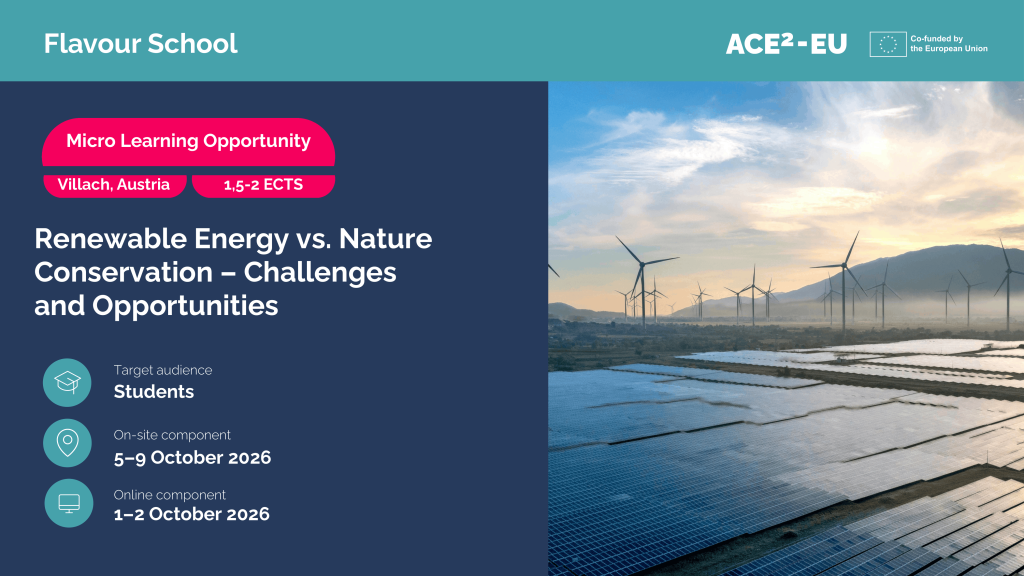
Renewable Energy vs. Nature Conservation- Challenges and Opportunities

Course Type: Flavour School
Duration and Learning Format
Provide a clear overview of the course structure, including:
- Total workload: 44-55 hours
- Synchronous online activities: 7-10 hours
- On-site (physical mobility) activities: 30 hours
- Independent and group work: 7-10 hours
- Dates of:
- Online component: October 1st-2nd
- On-site component: October 5th-9th Villach, Austria
Credits and Certification
1,5-2 ECTS
Organising Institutions and Teaching Staff:
Lead and Host Institution
Carinthia University of Applied Sciences
- Evan Vincent
Partner Institutions
Lithuania University of Applied Engineering Sciences
- Egidijus Kasiulis
External stakeholders
- Verbund, APG (Austrian Power Grid)
Course Overview
The goal of this course is to educate students about topics related to renewable energy infrastructure and how it conflicts with nature conservation objectives. As part of the European Green Deal, the EU aims to be carbon neutral by 2050. Transitioning to renewable energy will be one of the main focuses in achieving this ambitious but necessary goal. This increase in infrastructure development and land-use pressure will inevitably impact nature. Our goal as planners, engineers, conservationists, and citizens is to work together to mitigate these impacts so that our goal of becoming carbon neutral doesn’t outweigh our obligation to preserve and protect species, habitats, and the ecosystem services that they provide us with. Examples of this conflict include hydropower plants preventing fish migration, birds and bats colliding into windmills, and grid expansion affecting sensitive biotopes and habitats.
Learning Journey
Online sessions:
- Ace Rookies MOOC completion
- Introduction to the Participants: Background of lecturers and students
- Introduction to the course: Key concepts
- Course agenda
- Knowledge-Base: What do students currently know about the topic
- Guiding Questions and discussions in smaller groups
Onsite sessions:
- Theory: Lean about case studies that are representative examples of this conflict in Europe. Location: FH Kärnten Oct. 5
- Fieldwork: Excursions to hydropowerplants, windmills, and other sites that highlight conflicts and opportunties. Location: Various sites in Carinthia Oct 6-7
- Challenge-based or project work: Workshops focusing on the dilemma between renewable energy expansion and conservation of habitat and species. Location: FH Kärnten Oct. 8
- Final Presentations: Groups deliver a presentation hilighting the outcome of their solution-oriented workshop. Location: FH Kärnten. Oct. 9
Follow-up / reflection:
- Online reflection activities addressing the course content, structure, and overall experience will be due at the end of the course.
This helps students understand how learning is consolidated after the on-site phase.
Learning Objectives
Specific learning objectives include:
Collaborate with other students from different countries
Analysis of current conflicts that are present in Austria and in their own countries
Experience real word examples in Austria through excursions to hydropower plants, energy grid infrastructure, and windmills
Critical thinking of potential solutions to the conflicts addressed in this course using an interdisciplinary approach
Learning Outcomes (By the end of the course, students will be able to):
- Have a foundational grasp on the state of the art: the conflict between renewable energy and nature conservation
- Identify potential solutions for this conflict
- Collaborate with other students from other universites within a cross-cultural setting
Which students would find this course useful for them?
This course may be suitable for students from ACE2-EU partner universities enrolled in undergraduate or postgraduate programs in the following fields:
Indicate:
- Level: Undergraduate
- Engineering, Architecture, Ecology, Environmental Policy,
This course may be suitable for those who have an interest in:
You may also include:
- Those interested in combining engineering with ecology and creating public policy that address these topics. Anybody who feels like they can contribute to this theme from a different educational background or is just generally interested in learning about the topic is warmly invited to participate!
- Recommended Language Level :
- English B1–B2
This is mandatory, as English is the working language of ACE²-EU courses.
Application Process:
Interested applicants should
🔗 Apply here: https://forms.gle/Kt36MNng6cxrJk3R9
Deadline for receipt of applications: 20 July 2026
A notification of acceptance to participate will be sent to successful applicants by the host institution. Prior to the start of the course, participants will receive a welcome email from the ACE²-EU Alliance with detailed instructions specific to the course.
Further Information
For any further information or queries related to the course, please contact: e.vincent@fh-kaernten.at