- This event has passed.
Designing Social Good: Bridging Sustainability and Project Management
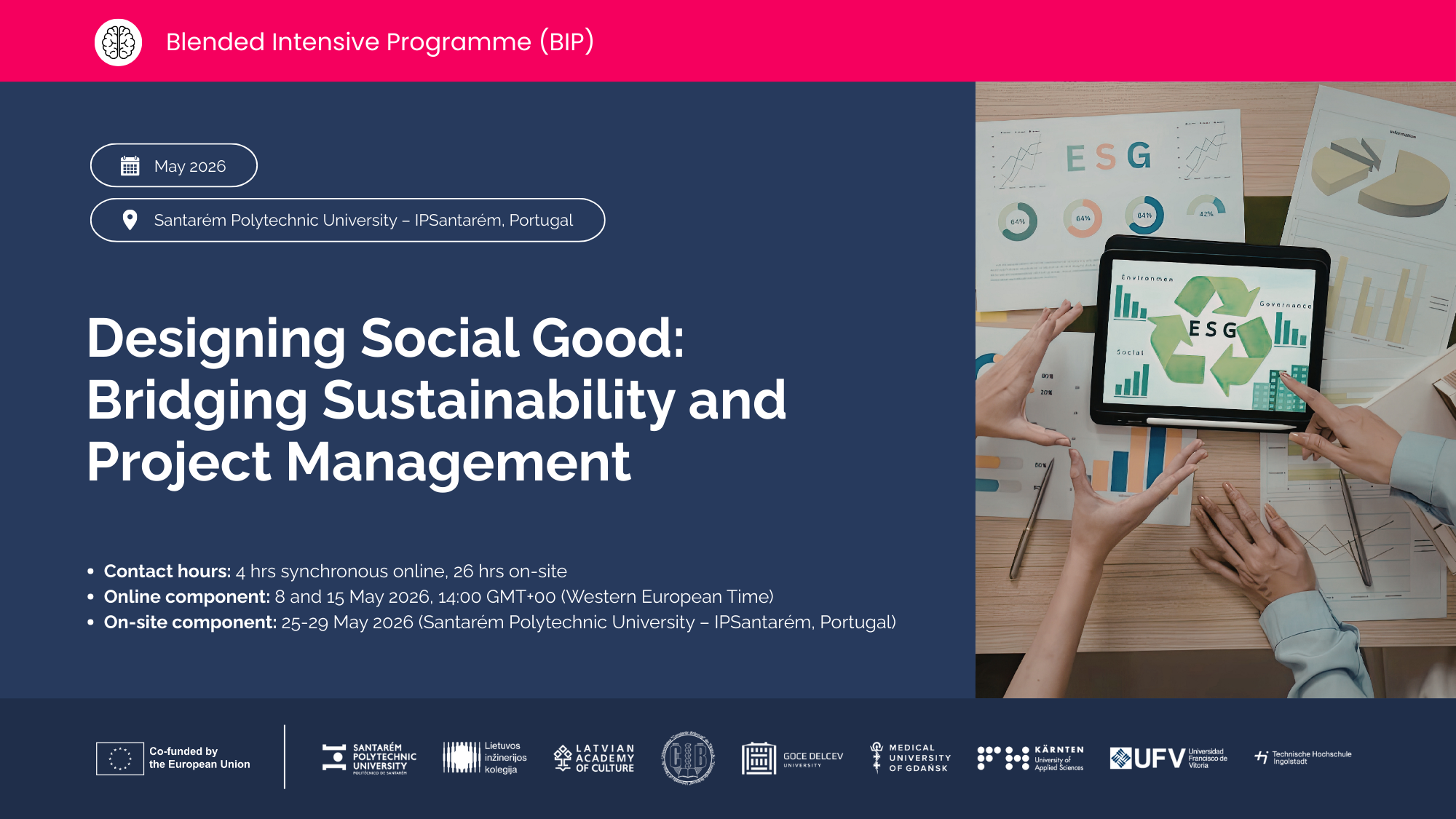
Course Type: BIP
Duration and Timeline:
- Contact hours: 4 hours synchronous online, 26 hours on-site
- Online component: 8 and 15 May 2026, 14:00 Time zone: GMT+00 (Western European Time)
- On-site component: 25-29 May 2026 (it will take place: SANTARÉM, Portugal)
Award, Credits and Certification
On successful completion of the course, participants will receive 3 ECTS credits and a certificate of attendance.
Organised by:
Name of the University (Country) Lead and Host Institution
Santarém Polytechnic University – IPSantarém, Portugal
Name of the University (Country)
Irene Ciccarino; Santarém Polytechnic University – IPSantarém
Austra Ciša and Elizabete Palasiosa; Latvian Academy of Culture (LAC), Latvia
Amalia Venera Todoruț; University Constantin Brâncusi Târgu-Jiu (UCB), Romania
Stefanie Wrobel; Technische Hochschule Ingolstadt (THI), Germany
External stakeholders that will be involved in the course:
PM4NGOs
Local NGOs
Course Description and Learning Objectives
What if your university experience could help you design real solutions for a more sustainable world? This Blended Intensive Programme (BIP) brings together students from different countries and disciplines to explore how project management can transform sustainability and social good into tangible action. Working in multicultural teams, you help create social impact by addressing this real question: What are the challenges and benefits of establishing a local PM4NGOs Hub, and what advantages can it offer to universities, NGOs, and communities? Using a problem-based methodology rooted in design thinking, you will analyse real-world contexts, identify problems, and co-create practical, sustainability-driven solutions. This BIP equips students with knowledge and tools to foster purpose and meaning in any career, expanding perceptions of social good. It encourages understanding of how effective project management drives innovation, resilience, and sustainable impact. Together, we can make the world better — one project at a time.
Course Description:
- Online sessions: There will be two online sessions, each lasting 1,5 hours. This session will cover online (e.g., introduction to key concepts, group discussions, preparatory work). Include indicative dates.
- First Welcome section: Acexperience + Presentation of teachers, programme and venue. Design thinking methodology explanation. Introduction to key concepts such as sustainability, social good and project management. Digital activity applying the concepts.
- Second Case Study Presentation: Presentation of PM4NGOs by its executive director, explanation of the challenge, Q&A to prepare for on-site sessions.
- On-site sessions: Students will be welcomed in Portugal at the Faculty of Management and Technology of Santarém Polytechnic University. After the opening ceremony, teams will be formed, and the countries serving as the challenge context will be chosen. During the BIP, students from across the alliance will work in multicultural teams to explore how and why a Hub could be implemented in their country. The challenge is structured into three parts: 1) context analysis, 2) identifying real problems, and 3) designing practical solutions using core project management tools such as the triple constraint, stakeholder mapping, cost–benefit analysis, risk assessment, and theory of change. It is a hands-on method in which the teacher mentors the learning process. Each day, students will attend brief lectures introducing tools and concepts relevant to the challenge. Teachers will be available to mentor teamwork. By Friday, teams must organise their materials to participate in a fair open to the community, where they will present their ideas. The best team will be chosen by popular vote and teacher assessment, with recognition at the closing ceremony.
- Follow-up / reflection: Students will fill out an online Diagnostic survey in advance of the first online meeting to help develop tools and lectures that support their learning. In the last 0n-site day, they will also answer an online perception survey to highlight what they have learned and their satisfaction with the BIP.
Specific learning objectives include:
Knowledge & Understanding:
- Understand key concepts of project management: triple constraint, stakeholder mapping, cost–benefit analysis, risk assessment, and theory of change.
- Recognise the Social Good concept in driving sustainability-oriented impact.
Skills:
- Autonomy in learning and decision-making.
- Problem-solving applying creative and design thinking.
- Apply project management tools to design feasible and sustainability-aligned solutions.
- Work collaboratively in multicultural teams to make evidence-based decisions.
- Communicate project proposals visually through structured outputs (Context → Problem → Solution posters).
Attitudes:
- Develop intercultural sensitivity, collaborative work, and ethical awareness.
- Value the importance of professional project management skills as a driver of sustainable actions.
By the end of the course, students will be able to: understand the fundamentals of project management and social good, while also applying sustainability in practice.
Which students would find this course useful for them?
This course may be suitable for students from ACE2-EU partner universities enrolled in undergraduate or postgraduate programmes in the following fields:
-
- Any student interested in sustainability and purpose-driven development
- Students interested in developing skills to work in multicultural teams
- Students interested in developing design thinking skills
This course may be suitable for those who have an interest in:
-
- Business and management
- Sustainability
- Project management
- Social economy (NGOs, social networks, social movements)
- Social sciences
- Recommended language level:
- Basic to intermediate level of English (B1-B2), as the working language will be English
Important notice:
Participation in this Blended Intensive Programme (BIP) is subject to confirmation by the student’s home institution. As funding arrangements may vary, interested students are advised to contact their University’s International Relations Office for information on eligibility, funding availability, and participation conditions before applying.
Application Process:
Interested applicants should
🔗 Apply here: https://forms.office.com/e/xKzXbUqvU7
Deadline for receipt of applications: 20 February 2026
A notification of acceptance to participate will be sent to successful applicants
Further Information
For any further information or queries related to the course, please contact: irene.ciccarino@esg.ipsantarem.pt