7th ACEPLORATION – Universidad Francisco de Vitoria (Spain)
Call for Participation
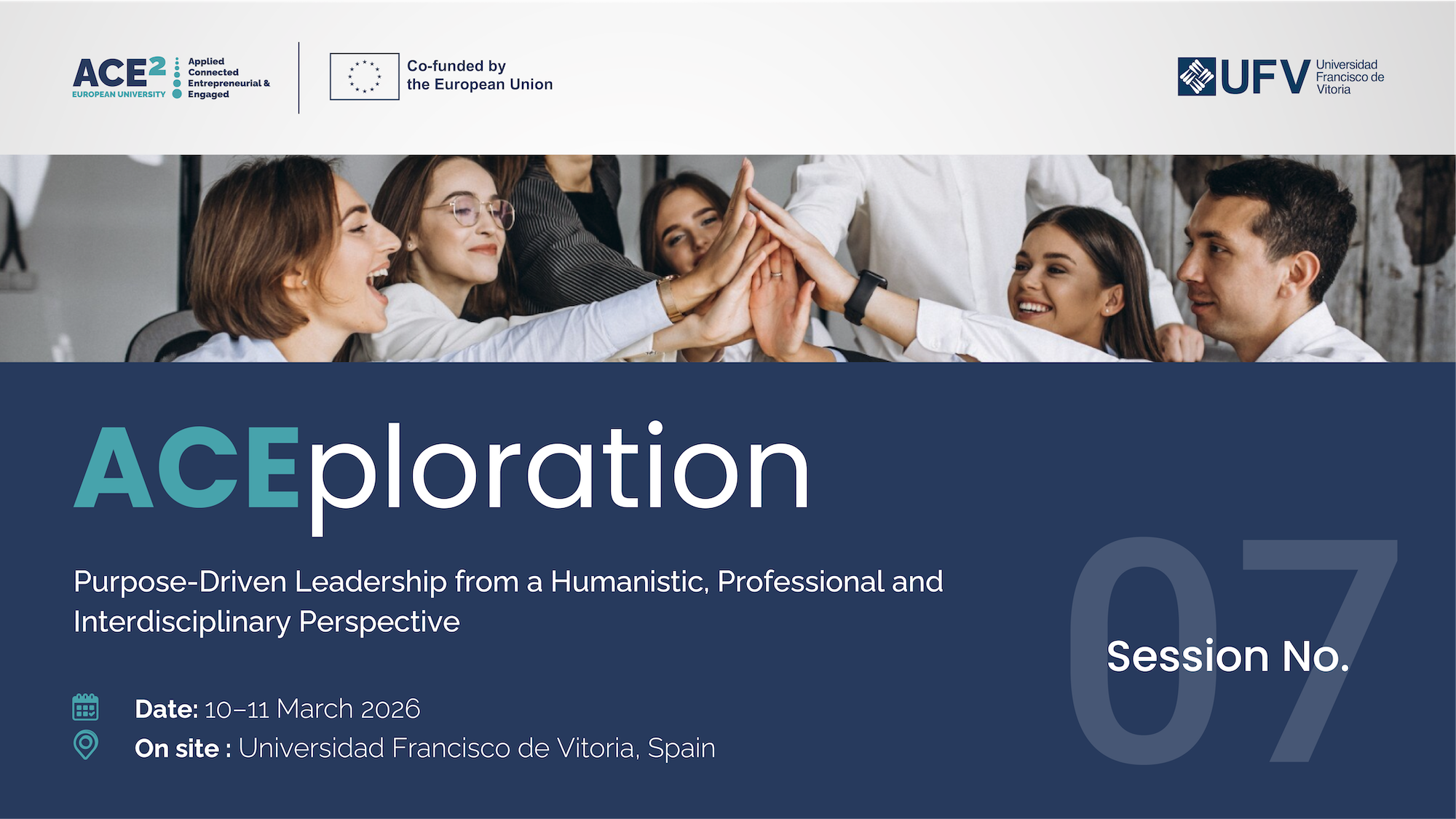
The ACE²-EU European University Alliance invites academic staff from partner universities to participate in the 7th ACEploration, hosted by Universidad Francisco de Vitoria (UFV) during the days 10-11 March 2026.
This ACEploration is conceived as a space for academic co-creation and strategic dialogue, bringing together professors from across the Alliance to design joint learning opportunities and advance innovative educational initiatives with a strong humanistic and societal orientation.
About ACEploration
ACEploration is a flagship initiative of the Applied Programmes and Pedagogy Factory (WP2 – APP Factory) within the ACE²-EU Alliance.
Each ACEploration:
- is hosted by a different partner university,
- brings together academic staff from across the Alliance,
- focuses on the co-creation of joint learning opportunities, innovative pedagogical formats and future-oriented academic initiatives.
The missions are designed as working laboratories, combining structured dialogue, interdisciplinary exchange and collaborative academic design.
Objectives of the ACEploration
The main objectives of the ACEploration missions are to:
- Develop and plan joint academic learning opportunities across the Alliance.
- Strengthen institutional and academic collaboration within ACE²-EU.
- Support the co-creation of innovative pedagogical formats and joint programmes.
- Enhance faculty and student mobility opportunities.
- Engage with societal and external stakeholders to align education with real-world challenges.
- Promote digital and green transition approaches through collaborative learning models.
Theme of the ACEploration
Purpose-Driven Leadership from a Humanistic, Professional, and Interdisciplinary Perspective
This ACEploration explores leadership as a transformative force grounded in:
- personal purpose and ethical responsibility,
- professional excellence and real-world impact,
- interdisciplinary dialogue and collaboration.
The theme reflects UFV’s educational model, which places the person at the centre and understands leadership as a service to society and the common good.
Subthemes
- Personal, Ethical and Humanistic Leadership
(Humanities, Education, Psychology, Philosophy, Health Sciences)
This subtheme explores leadership from a person-centred and ethical perspective, integrating:
- human dignity, anthropology and professional vocation,
- self-awareness, emotional intelligence and character development,
- ethical leadership in professions with direct impact on people (education, healthcare, guidance, accompaniment).
UFV contribution:
A transversal humanistic foundation that characterises UFV’s educational model and serves as a common axis across disciplines.
- Professional and Organisational Leadership in Complex Environments
(Business, Economics, Law, Engineering, Communication, Social Sciences, Arts)
This subtheme focuses on leadership applied to organisations and complex systems, addressing:
- leadership in companies, public institutions and third-sector organisations,
- strategic decision-making, governance and social responsibility,
- management of multidisciplinary teams, innovation and digital transformation.
UFV contribution:
A strong link between leadership, professional development, employability and real-world impact.
- Leadership for Social Transformation and the Common Good
(International Relations, Communication, Education, Law, Business, Social Sciences)
This subtheme orients leadership towards social and territorial commitment, including:
- leading projects with social, educational or community impact,
- collaboration with public administrations, civil society and external stakeholders,
- global leadership, international cooperation and sustainability.
UFV contribution:
Alignment with UFV’s institutional mission of service, social commitment and education for transformation.
Joint Learning Opportunities and Academic Co-Creation
During this ACEploration, participants will collaboratively work on the co-creation of joint learning opportunities within the ACE²-EU Alliance, combining short-term pedagogical innovation with longer-term academic development.
Academic staff will be organised into two complementary working groups, allowing participants to contribute according to their expertise while ensuring tangible and future-oriented academic outcomes.
The first working group will focus on the design of microlearning opportunities, developing short, flexible and innovative learning formats that respond to emerging educational needs, foster skills development and support agile academic collaboration across partner institutions.
The second working group will concentrate on the academic co-design of Joint Master’s Degrees and Joint PhD programmes. Professors participating in this group will collaboratively develop the academic content of the programmes, defining the different learning pathways and training itineraries, as well as thematic specialisations and progression routes. The work will be centred on curriculum design and academic coherence, drawing on the complementary academic strengths of the partner universities.
Together, these working groups will generate concrete academic outputs that contribute to the consolidation of joint educational offerings within the Alliance.
Expected Outcomes
The expected outcomes of this ACEploration include:
- Development of joint learning opportunities.
- Strengthening of academic and institutional collaboration frameworks within ACE²-EU.
- Expansion of faculty and student mobility initiatives.
- Formalisation of academic collaborations that may lead to future joint programmes.
- Documentation of best practices to support future ACEploration missions.
Participation Details
- Each ACE²-EU partner university is invited to nominate at least two academic staff members.
- Participants should align their academic expertise with the ACEploration theme and subthemes.
- Nominated professors from each institution should collectively cover different subthemes, avoiding overlap and ensuring diversity of perspectives.
- Participation requires attendance at all stages of the ACEploration process.
Key Dates
- Pre-briefing meeting (online): 20 February 2026
- ACEploration (on-site at UFV): 10–11 March 2026
- Post-ACEploration review (online): 26 March 2026
Call for Nominations
Partner universities must submit their nominations by 17 February 2026 via the official registration link.
All nominated participants are expected to attend:
- the pre-briefing meeting,
- the on-site ACEploration,
- the post-ACEploration review meeting.
Contact
For further information about this ACEploration, please contact:
📩 chelo.perez@ufv.es