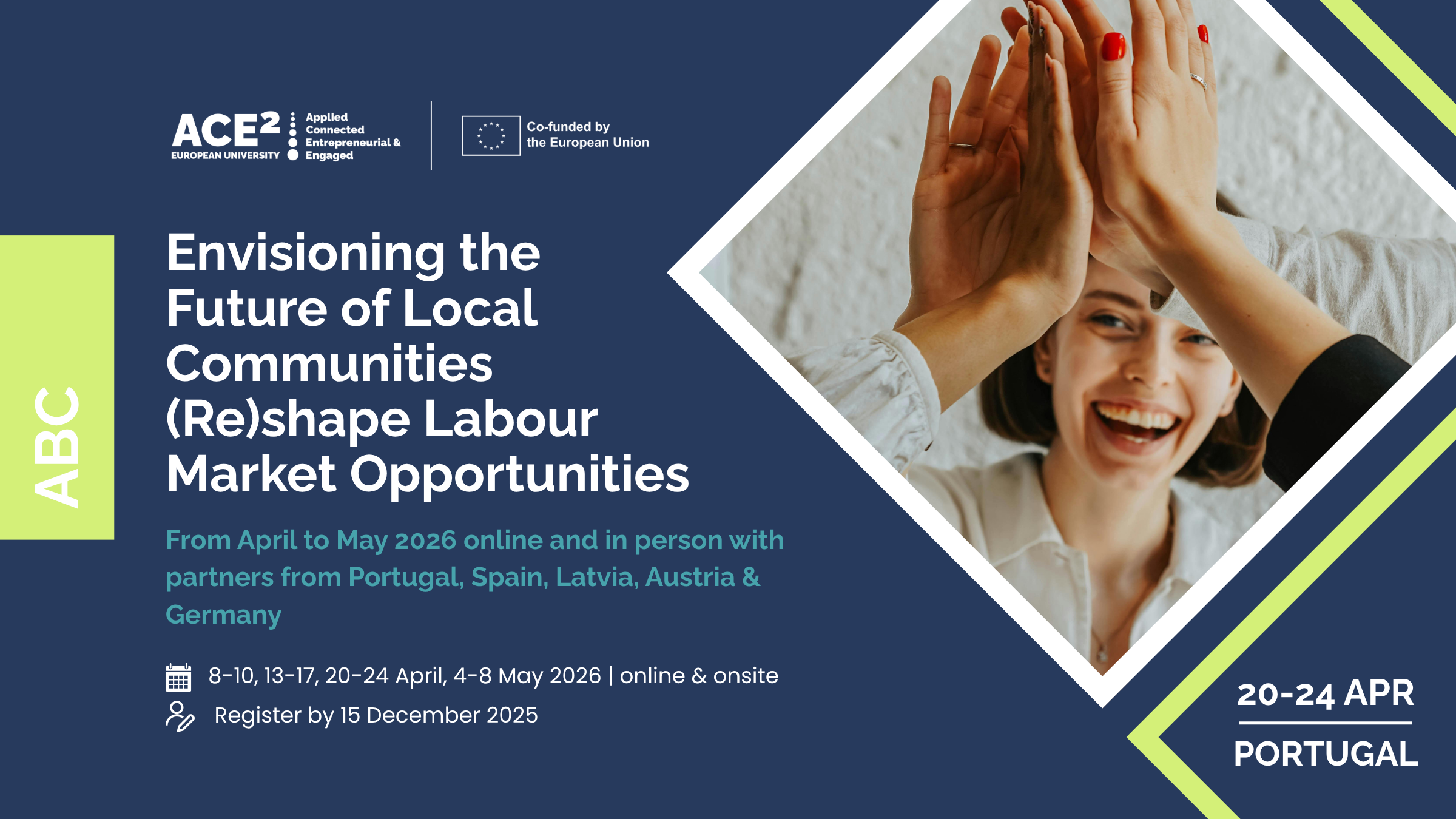
Envisioning the future of local communities (re)shape labour market opportunities
Course Type: Applied Blended Challenge (ABC) Programme
Duration and Timeline:
- Course components and contact hours: 12 hrs synchronous online, 25 hrs onsite + 38 hrs independent and group work
- Online component:
1st week: 8 – 10 April (online) CET time
2nd week: 13 – 17 April (online) CET time
4th week: 4 – 8 May (online) CET time
- On-site component:
3rd week: 20 – 24 April (face-to-face) Santarém, Portugal
Award, Credits and Certification
On successful completion of the course participants will receive 3 ECTS credits and a certificate of attendance
Organised by:
Santarém Polytechnic University
- Tatiana Ferreira – tatiana.ferreira@ese.ipsantarem.pt;
- Perpétua Santos Silva- perpetua.silva@ese.ipsantarem.pt
- Paula Ruivo – paula.ruivo@esa.ipsantarem.pt;
- Rosa Coelho – rosa.coelho@esa.ipsantarem.pt;
- Céu Godinho – maria.godinho@esa.ipsantarem.pt
University of Francisco de Victoria:
- Agustina Jutard a.jutard@ufv.es;
- María José Díaz m.diaz@ufv.es
Technische Hochschule Ingolstadt
- Ulrich Schlickewei – ulrich.schlickewei@thi.de
Latvian Academie of Culture
- Ieva Zemīte – ieva.zemite@lka.edu.lv
Carinthia University of Applied Sciences
- Birgit Aigner-Walder – B.Aigner-Walder@fh-kaernten.at
External stakeholders that will be involved in the course:
- European Rural Youth Observatory
- Municipality of Santarem
- Local Employment Services
- Vititejo-Association of Winegrowers of the Tejo Region
- Association of Farmers of Ribatejo
Course Description and Learning Objectives
SHORT DESCRIPTION:
- Fully applied programme focused on labour market future trends and local communities’ resources;
- Involve students as key actors in the identification of real-world problems in their communities;
- Participants will work on real-life cases alongside key stakeholders and business from local communities.
GENERAL OBJECTIVES:
- Improving the quality of life of local communities
- identify emerging local economies (e.g. renewable biological resources, technology, and innovation)
- envisioning future workforce needs;
- enhancing local resources.
- Empowering participants with the skills and awareness to (re)think their future pathways in the labour market, promoting innovation and community-oriented growth;
- Connect and build bridges between participants, universities (scientific knowledge), stakeholders and local economies;
- Strengthening collaboration between universities, students, local businesses and policymakers.
- Addressing real-life challenges in collaboration with stakeholders, local business/institutions.
Course Description:
Pedagogical approach
- Mentorship & networking sessions with professionals from local businesses and industries
- Foresight Methodology
- International mobility – one week of training at another ACE2-EU university.
- Practice-oriented activities –interactive exercises, collaboration with real stakeholders, projects co-design.
- Real-World problems: focus on identification and solving of real-world problems.Hands-on experience – innovative problem-solving using student’s diverse disciplinary perspectives
METHODOLOGICAL APPROACH
A) Lecture – theoretical background through seminar presentations
B) Experiences’ Exchange between participants from different universities – use of participatory and foresight methodologies
C) Practice-oriented activities – interactive exercises, collaboration with stakeholders, projects co-design
- Real-World problems: focus on identification and solving of real-world problems
- Hands-on and collaborative work – in this step each group will develop their community-based projects proposals
- Collaborative, local and youth-centred solutions – young people community-based projects proposals developed collaboratively with stakeholders
D) Pitch presentations – share in a larger group of the community-based projects proposals
E) Asynchronous Online Work Strategies – Guided Readings; Video Analysis Activities; Thematic Discussion Forum; Gamified Challenges; Collaborative Document Creation.
Participants are expected to:
- Complete readings and tasks (online modules)
- Engage actively in both online and face-to-face activities
- Collaborate on a group challenge project
- Deliver a pitch presentation of the project outcomes
- Submit a final written proposal and an individual reflection report
STRUCTURE – thematic lines
Module 1: Understanding Local Labour Market Dynamics
- Exploring existing local industries – foster place-based industries (viticulture, wine-tourism, eco-tourism, agriculture, manufacturing)
- Identifying challenges: employment gaps, infrastructure, policy limitations
- Fieldwork: visits to local businesses and industries
Module 2: Innovation & Sustainability in Communities Development
- Green economy & sustainable practices (shift toward climate-neutral economies, bioeconomy-aligned jobs support both environmental goals and economic revitalization)
- Tech-enabled solutions for local business and industries growth
- Case studies of successful local businesses and industries
Module 3: (social) Entrepreneurship & Intrapreneurship
- Community-driven solutions for job creation (e.g. circular use of local biomass – agricultural waste)
- Business models and future market needs
Module 4: Field Engagement & Real-World Application
- Hands-on with stakeholders, local entrepreneurs and policymakers
Specific learning objectives include:
Please list clear and measurable objectives that students should achieve by the end of the course.
By the end of the course, students will be able to:
- Analyse real-world problems, question assumptions, and make evidence-based decisions
- Learn participatory techniques through hands-on experience of co-development and participatory methods
- Work effectively in diverse teams and co-create with peers and local stakeholders
- Identify local challenges and design realistic, context-sensitive solutions
- Communicate ideas clearly and persuasively to different audiences
- Value diversity and understand rural realities across Europe
- Apply creative approaches to generate ideas and shape solutions
- Define goals, set timelines, allocate resources, and structure proposals
- Take initiative, lead with empathy, and promote positive change
Which students would find this course useful for them?
- This course is open to all students from ACE2-EU, independently of their area of knowledge, 4 students per ACE University.
This course may be suitable for those who have an interest in:
- Local communities/economies development
- Local Labour Market Dynamics (viticulture, wine-tourism, eco-tourism, agriculture, manufacturing)
- Green economy & sustainable/innovative practices
- Tech-enabled solutions for local business and industries
- Community-driven solutions for job creation
- Recommended Language Level :
- Basic to intermediate level of English (B1 – B2), as the working language will be English
Application Process:
Interested applicants should
🔗 Apply here: https://forms.gle/c1FrG3YMzZRJnuac9
Deadline for receipt of applications: 15 December 2025
A notification of acceptance to participate will be sent to successful applicants
Further Information
For any further information or queries related to the course, please contact:
Email: Perpétua Santos Silva- perpetua.silva@ese.ipsantarem.pt ; Tatiana Ferreira – tatiana.ferreira@ese.ipsantarem.pt;