Soil Moisture Regulation in the Context of Climate Change
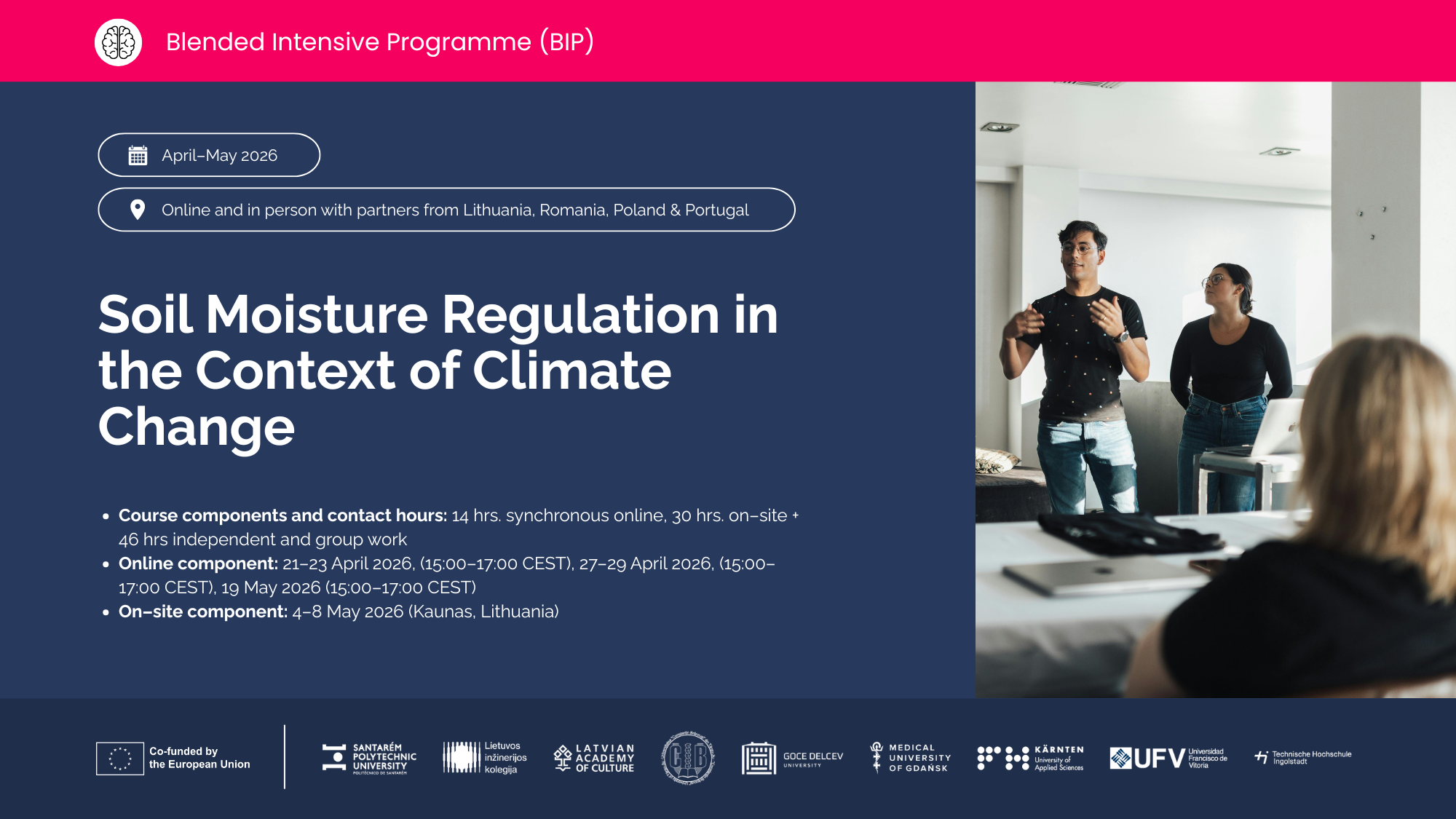
Course Type: Blended Intensive Programme (BIP)
Duration and Timeline:
- Course components and contact hours: 14 hrs synchronous online, 30 hrs on–site + 46 hrs independent and group work
- Online component: 21 – 23 April 2026, (15:00 – 17:00 CEST), 27 – 29 April 2026, (15:00 – 17:00 CEST), 19 May 2026 (15:00 – 17:00 CEST)
- On–site component: 4 – 8 May 2026 (it will take place: Kaunas, Lithuania)
Award, Credits and Certification
On successful completion of the course, participants will receive 3 ECTS credits and a certificate of attendance
Organised by:
Lietuvos inžinerijos kolegija/Higher education institution (Lithuania) – Lead and Host Institution
Vilda Grybauskienė (Lietuvos inžinerijos kolegija)
Gitana Vyčienė (Lietuvos inžinerijos kolegija)
Constantin Brâncuși University (Romania)
Catalin Schiopu (Constantin Brâncuși University)
Irina Pecingina (Constantin Brâncuși University)
Medical University of Gdansk (Poland)
Maciej Tankiewicz (Medical University of Gdansk)
Milena Lachowicz (Medical University of Gdansk)
Agrarian Superior School of Santarém IPSantarém (Portugal)
Olfa Zarrouk (IPSantarém)
Nuno Conceicao (IPSantarém)
External stakeholders involved in the course:
Andrius Marinas – Association of Land Reclamation, President
Vidmantas Pauliukevicius – Farmer
Course Description and Learning Objectives
This course explores the impact of climate change on soil moisture, drought stress, and agricultural sustainability. Students will study biological soil additives such as biochar, compost, and microbial inoculants, and gain hands–on experience through lab demonstrations, field practices, and ecotoxicity assessments. Emphasis is placed on practical application strategies, cost–benefit considerations, and policy frameworks like the EU Green Deal. The course also integrates a medical perspective, addressing how soil and crop management influence food safety, nutritional value, and public health. Students will examine how reducing chemical inputs and mitigating ecotoxicity risks contribute to healthier diets and long–term disease prevention. In this way, the course links sustainable agriculture with healthy lifestyles and the promotion of overall human well–being. The course concludes with collaborative projects and reflection on innovations for climate–resilient, health–oriented agriculture.
Course Description:
Provide a more structured explanation of the course, dividing it into its main components:
- Online sessions: 21 – 23 April 2026, (15:00 – 17:00 CEST), 27–29 April 2026, (15:00 – 17:00 CEST),
- Students will learn about implementation strategies and field practices involved in the ecotoxicity assessment of soils; application of soil moisture sensors, crop yield analysis, and microbial community testing for evaluating the performance of biological soil additives; and EU Green Deal with related subsidy mechanisms that promote climate–adaptive agricultural practices. In addition, attention will be given to how sustainable soil management contributes to food safety, nutritional quality, and ultimately healthier lifestyles, linking agricultural innovations with public health and disease prevention.
- On–site sessions: 4 – 8 May 2026
Lectures: Theoretical foundations addressing climate change, soil moisture dynamics, and the role of biological additives, with a particular focus on their implications for food safety, nutritional value, and human health. The course highlights how sustainable soil management practices not only enhance agricultural resilience but also support disease prevention and healthier lifestyles.
Seminars/Group Discussions: Critical examination of local and regional drought impacts and their implications for agricultural systems and the availability of nutritious, safe, and diverse food essential for healthy diets.
Laboratory Activities: Comparative experiments assessing water retention in treated versus untreated soils.
Case Study Analysis: Practical insights derived from farmers’ experiences with biological additive use, emphasising how these practices contribute to producing safer, more nutritious food and promoting healthier lifestyles.
Reflective Exercise: Consideration of future innovations required to enhance climate–resilient agriculture.
- Follow–up / reflection: 19 May 2026 (15:00 – 17:00 CEST)
- online final project presentation (Create an additive application plan for a drought–prone farm scenario) and reflection.
Specific learning objectives include:
To understand how biological soil additives can improve moisture retention and resilience under climate stress, and how they contribute to sustainable soil management.
Learning Outcomes:
- Understand soil moisture challenges in the context of climate change;
- Identify and describe technological solutions for moisture regulation;
- Analyse their mechanisms of action and field application methods;
- Evaluate the sustainability, effectiveness, and scalability of bio–additives;
- Propose a practical implementation plan for a given climate scenario;
- Conduct practical training on ecotoxicity assessment of soil;
- Recognise the link between sustainable soil management, food safety, and healthy nutrition as part of a broader healthy lifestyle.
By the end of the course, students will be able to:
- Identify and classify key biological additives (e.g., biochar, compost, mycorrhizae, humic substances) relevant to sustainable soil moisture management.
- Understand the mechanisms by which these additives influence soil structure, water retention, plant resilience, food quality and healthy lifestyle.
- Apply practical methods for incorporating biological additives into different agricultural systems, tailored to soil type and climate and healthy food systems.
- Assess the environmental and economic benefits of using biological soil amendments in the context of climate change adaptation.
- Evaluate real–life cases and farmer experiences to inform decision–making in sustainable land, water and food as circular system management.
Which students would find this course useful?
This course may be suitable for students from ACE2-EU partner universities enrolled in undergraduate or postgraduate programmes in the following fields:
- Agriculture
- Soil Science
- Environmental Sciences
- Health Sciences
- Sustainable Agriculture
This course may be suitable for those who have an interest in:
- Sustainable Farming
- Soil Health
- Climate Change Adaptation
- Health Sciences
- Recommended Language Level:
- Basic to intermediate level of English (B1 – B2), as the working language will be English.
Application Process:
Interested applicants should
🔗 Apply here: https://forms.gle/f7artVN6mnXusGT9A
Deadline for receipt of applications: 20 January 2026
Further Information
For any further information or queries related to the course, please contact:
Vilda Grybauskienė vilda.grybauskiene@lik.tech