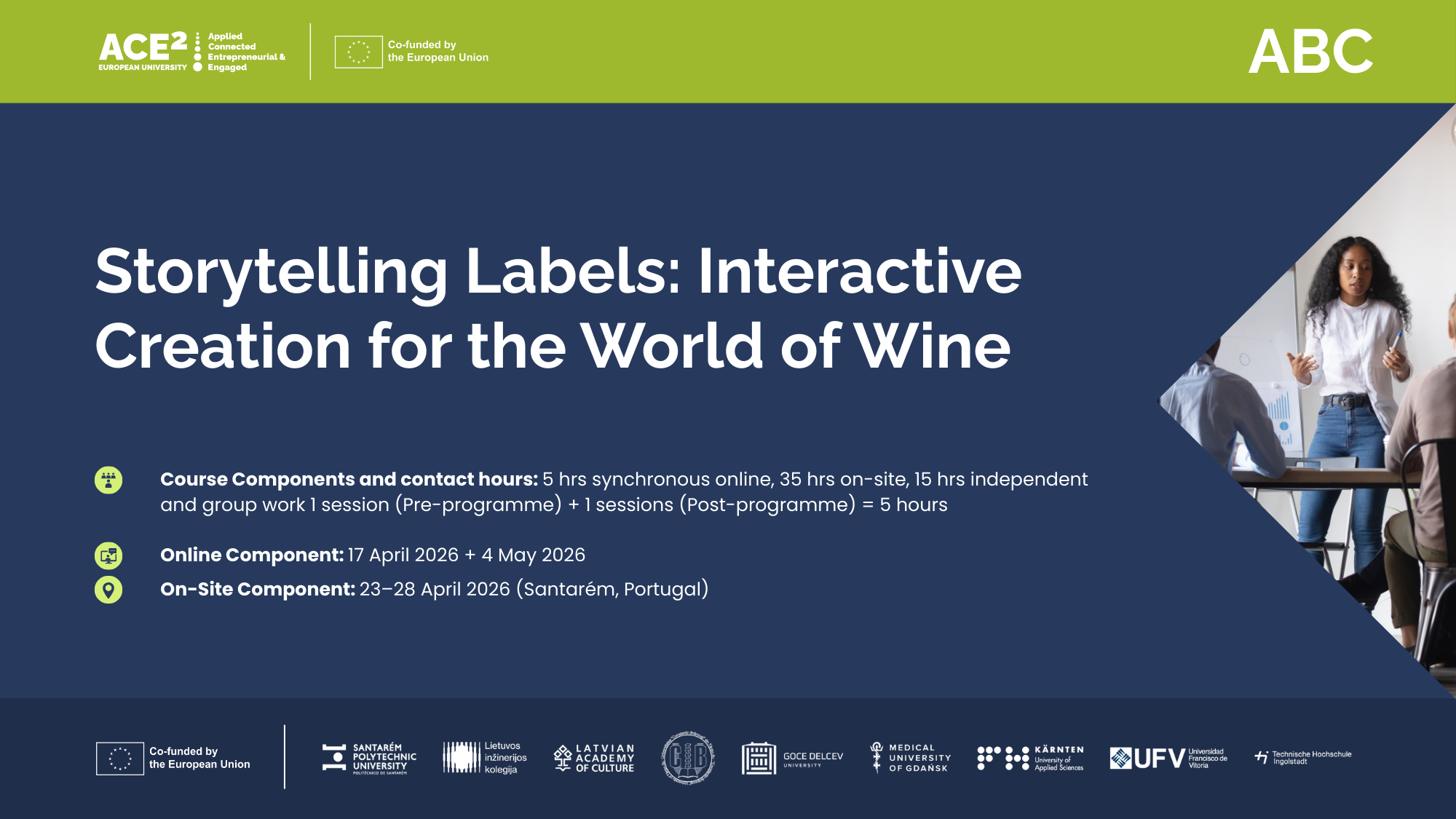
Storytelling Labels: Interactive Creation for the World of Wine
Course Type: Applied Blended Challenge (ABC) Programme
These are blended credit-bearing programmes which use a challenge-based pedagogical approach will involve a minimum of one mobility week for participating students and will be open to students from all ACE2-EU Alliance members. The main aim of ABCs is to allow students to work collectively on developing work plans and solutions focused on solving real-world challenges identified by external stakeholders relevant to EU priority areas, through a blended challenge-based pedagogical approach.
Duration and Timeline:
- Course Components and contact hours: 5 hours synchronous online, 35hours on-site, 15 hours independent and group work 1 session (Pre-programme) + 1 sessions (Post-programme) = 5 hours
- Online Component: April 17th 2026
- On-Site Component: April 20-24 2026 (Santarém, Portugal)
- Final presentation – Online activity and assessment with the stakeholders: May 4 2026
Award, Credits and Certification
On successful completion of the course participants will receive 3 ECTS credits and a certificate of attendance
Organised by:
- Santarém Polytechnic University (Portugal) Lead and Host Institution
Professor João Cabral
Professor Helena Mira
Professor Paula Lúcia Ruivo
- Universidad Francisco de Vitoria (Spain) Co-creator Institution
Professor Manuel Casal
Professor Maribel Castro Diaz
- Latvian Academy of Culture
- Carinthia University of Applied Sciences
External stakeholders that will be involved in the course:
TBD
- QUINTA DE LAGOALVA (Portugal)
Main place where the work will be done: The Lagoalva Group has various business areas, such as: wine and olive oil, wine tourism, agriculture and horse breeding.
- TEJO WINE COMMISSION (Portugal)
”Tejo wine commission” refers to wines produced in the Tejo wine region of Portugal, formerly known as Ribatejo. This region is located in central Portugal, along the banks of the Tagus River (Rio Tejo), and is known for its fertile lands and diverse range of wines. The area is also home to the “Rota dos Vinhos do Tejo” (Tejo Wine Route), an established tourist route that promotes the region’s wine and cultural heritage.
- Objectives of the Call
– Develop interactive wine labels that respect European legislation and enhance heritage, culture and purchasing and consumption behaviour, integrating graphic design, storytelling, emerging technologies and sensory marketing, with a focus on innovative strategies for differentiation in the wine market.
- Analysing the role of the label as a means of communicating the brand in the wine sector, understanding its legal requirements, cultural framework and its ability to enhance the heritage and identity of the terroir – understood as the set of natural, cultural and human factors that characterise the origin of the wine.
- Develop interactive wine labels that combine storytelling, graphic design, emerging technologies (such as augmented reality) and sensory strategies, in line with current purchasing and consumption habits and preferences.
- Present and justify the solutions created, clearly communicating the conceptual, visual and interactive proposal, with a focus on differentiating the brand and creating meaningful experiences for the consumer.
- Course Short Description
This course offers specialised training in the application of augmented reality (AR) to wine label design, focusing on visual and interactive innovation while ensuring full compliance with European Union wine labelling regulations.
Participants will learn to design smart labels that combine contemporary aesthetics, digital interactivity, and full adherence to EU Regulations (such as Regulation EU 2019/33 and EU 2021/2117), including requirements related to:
- Geographical origin and protected designation of origin (PDO/PGI);
- Alcohol content, ingredients, and allergens.
- Mandatory nutritional information (provided via QR Code, as per recent guidelines);
- Sustainability and digital labelling.
Beyond mastering the legal framework, students will explore graphic design tools and AR platform (Adobe Aero), developing interactive prototypes that connect consumers to the wine’s story, terroir, and sensory profile in an engaging way.
Course Highlights:
- Technical foundations of augmented reality applied to packaging.
- Critical analysis of current European wine labelling laws.
- Creation of immersive storytelling experiences for wine brands.
- Development of labels that combine AR with legal compliance and visual elegance.
- Market segmentation, targeting, and positioning; Customer insight and audience understanding
- Target Group
– Undergraduate students from ACE2-EU universities
– Open to any specialisation (no qualification needed) with interest in the areas of technologies, culture, design, heritage or tourism.
- Learning Objectives
- Apply creative methodologies to address real-world cultural challenges.
- Acquire spatial-design
- Understand how the wine industry is framed within a European regulation and requirements.
- Collaborate in international, interdisciplinary teams (technology, creation, wine industry).
- Present their proposals to stakeholders in a professional context.
- Develop designs and projects respecting the brand identity and adding value to it (creativity, differentiation, consistency).
– Use new languages and technologies to deliver the ideas.
- Structure & Methodology
Structure
Online Preparatory Phase
Wine as a cultural symbol; case studies; introduction to stakeholders.
Research and personal approach on the topic
Revision and discussion of materials and design production
Understand how wine industry is framed within a European regulation and requirements.
Mobility Week in Portugal (at IPS)
Mentoring sessions with faculty and stakeholders.
Photography session – Product photography
Video Session – Capture and edit short advertising videos
Selection of materials and prototype construction
Final production of designs in workshop
Usability Testing
Final presentation – Presentation of results to stakeholders
Online Final Phase
Results of usability tests
Final reflection and evaluations
Methodology
Project-Based Learning (Pbl)
Project-Based Learning (PBL), integrated with elements of Design Thinking and experiential learning.
Design Thinking Method
Empathising – Understand the needs, experiences, and emotions of people involved in the problem.
Defining – Clearly articulate the core problem based on insights gathered.
Ideation – Brainstorm and generate innovative ideas.
Prototyping – Develop tangible or visual representations of ideas.
Testing – Obtain feedback and refine the solution through cycles of improvement.
Multidisciplinary learning with a focus on:
European Union regulations for wine labelling, based on Regulation (EU) 2021/2117
Label Design
Augmented reality (AR) on wine labels
- Registration and Participation
Deadline for registration: 15 December 2025
https://forms.gle/9ub5fJR71JmZZSyk9
**Participants must attend the full session and contribute to collaborative tasks.
- Contact & Coordination
For any questions or support related to the course, please contact: